Monday, July 30, 2012

Finally getting the hook dirty.

In "Hold Fast...", published back in March of 2012, I wrote about the process we went through to select a new anchor for Brigadoon.

The technology we purchased was pretty new and the anchor turned out to be a work of art.  It's a beautifully crafted stainless steel Ultra.  I didn't want a stainless steel anchor.  They tend to speak to me of dock queen boats, owned by less than experienced owners, who see such shiny anchors as an ornament rather than functional ground tackle.  This opinion is supported by stories of people returning ordered stainless anchors for their mega-yacht because they were scratched.  And anchor -- scratched.  Go figure.


Then again the Ultra only comes in stainless and, even though that adds to the cost, I was more interested in the design and how it performed.

We had the Ultra on Brigadoon's bow pulpit for six months before actually trying it out.  Oh, we made plans to do so.  We were going out one weekend, then the weather was only fit for selected species of arctic ducks. We'd go out another and spent the night on a dock instead.  We went out another weekend, into the sound, and were tempted by our friend's handy mooring ball.  We had yet to spend the night on a mooring ball, or to try out our cool new mooring hook, so no anchoring in Blakely harbor that night.  After hearing that I had this shiny new anchor our host insisted that, next visit, we must anchor.  I agreed.

However, the first chance to finally deploy the Ultra was on an overnight trip to Lake Washington.  It was a beautiful day, full of good breeze, warm sun, and a stated goal of not touching land for the entire weekend.  We met that goal in two ways.  We spent the first night on a mooring ball on the south end of Union Bay, just outside the Montlake Cut.  The water was very shallow there but we scooted in and, with the depth sounder screaming we only had 4 feet of depth -- it was fooled by the weeds, we were sitting on the ball in about 10' of water.

The next morning found us drifting along towards Juanita Bay, on the northeast shore of Lake Washington.  We were watching the weather forecast for wind direction.  Out plan was to ensure we were as protected as possible from wind and waves.  If the wind was out of the north, we'd anchor in Juanita Bay for the first time.  It it was out of the south, our plan would change to Cozy Cove, where we have spent the night before.

With the winds out of the south, we chose Cozy Cove.  On our way there we decided to have a nice dinner on shore.  This was our only time touching down on shore the whole weekend.  After a nice dinner at Carrilon Point, we cruised Yarrow Bay, then headed deep into Cozy Cove.

The last time we were there was for a raft-up with two other boats.  All of us sat on my single 45# CQR and 100 feet of chain.  We were also held in place by a monster stump that we ended up lifting out of the water when we tried to leave the next day.

This time, we were determined to avoid that stump again, and try out the Ultra.  There was much discussion in the cockpit, as Kerry and I decided where to drop the anchor. She had a very good memory of drifting towards shore, with a huge stump hanging from our CQR the last time.  This time would be different.  It would be more different than I expected.

As we did last time, Kerry was on the wheel in the cockpit while I readied the anchor on the bow.

Let me pause at this moment to admonish some of the male captains out there that send an often smaller, physically weaker person, forward while they yell instructions from the cockpit.  That is usually their wife or girlfriend.  I wish you would stop doing this.  It reeks of sexism, shows us now terribly much you need to be in charge, and makes being a captain look like a badge of douche-baggery, not one of responsibility.  Just stop it.  Stop it now.  If you don't trust her on the wheel, then teach her to handle the boat. An anchorage, especially if it's not crowded, is a great place to start.  You likely have almost twice her strength. She's got to be smart enough to learn to stop at one spot in into the wind and back the boat gently under power.  Now, where was I?

So there I was at the bow and Kerry on the stern.  The last time we did this the CQR, good anchor though it may be, ended up skipping along the bottom as Brigadoon backed like a drunken sailor, until the anchor hooked the stump.  Now, I will admit, that may be due to our inexperience that the CQR skipped along but, I've heard they are prone to that in some conditions.

We reached the agreed upon spot with Kerry at the helm.  She stopped us in place and gave me time to drop the Ultra.  The wind gently pushed us back while Kerry did her best, which turned out to be excellent, to back us downwind as I paid out chain.  In 20 feet of water, i wanted a 5:1 scope so, when I saw the 100 foot tag on the chain pass the bow roller and touch the water, I snubbed the chain.

Brigadoon had drifted slightly sideways at this point. She does that due to her cutaway forefoot on the keel.  I watched the chain as Kerry stood ready on the engine.  Soon, the chain started pulling up and, in one very definitive action, she swing directly towards the trip bouy we had set.  I mean, she settled, hard.

I went to the stern to see just how hard she had set.  Placing the engine in reverse I gave her a good burst.  We were very well placed. The chain pulled up and we didn't move one bit.  I felt confident we were well set and could settle in for the night, a wonderful night.  Brigadoon shook off the numerous wakes from the ski and wake boats that play in Cozy Cove most of the afternoon.

Our night was peaceful and secure.  When I'd wake at night I'd take a peek about and note we had not moved aside from some gentle swinging about on the light winds.  There is something special, almost magical, about sitting there, not attached to land, enjoying a nice dinner of hot pasta and fresh bread.

The next morning, after about 20 minutes pulling on our reliable manual windless, and cleaning a few bushels of lake weed off the chain, we pulled the Ultra free.

How to plow a lake bed.

There ya go.  She's finally dirty.

I think we made a good choice here.  The way this anchor set was much quicker than I have ever experienced with any other anchor.  It felt secure all night.  It was easy to retrieve.  It wasn't cheap but I think that, like most of our buying decisions, buying high quality is worth it.


Wednesday, July 11, 2012

Quackers

I have a friend.  She has visited the boat the last few nights.  Last night, as a read on the dock, she sat two feet away, her bill tucked into her wings, her eyes closed, seemingly happy.

Oh, I have plied her with Cheerioes (tm) but there is a trustfulness about her.  I sit here, working on the new laptop/tablet and she shows up, behind me.

I've fed her twice today.  She doesn't get any more, but she doesn't leave.

It's good to have a ducky friend.

I call her Quackers.

Monday, July 2, 2012

And lo, for there were upgrades ... and maintenance.


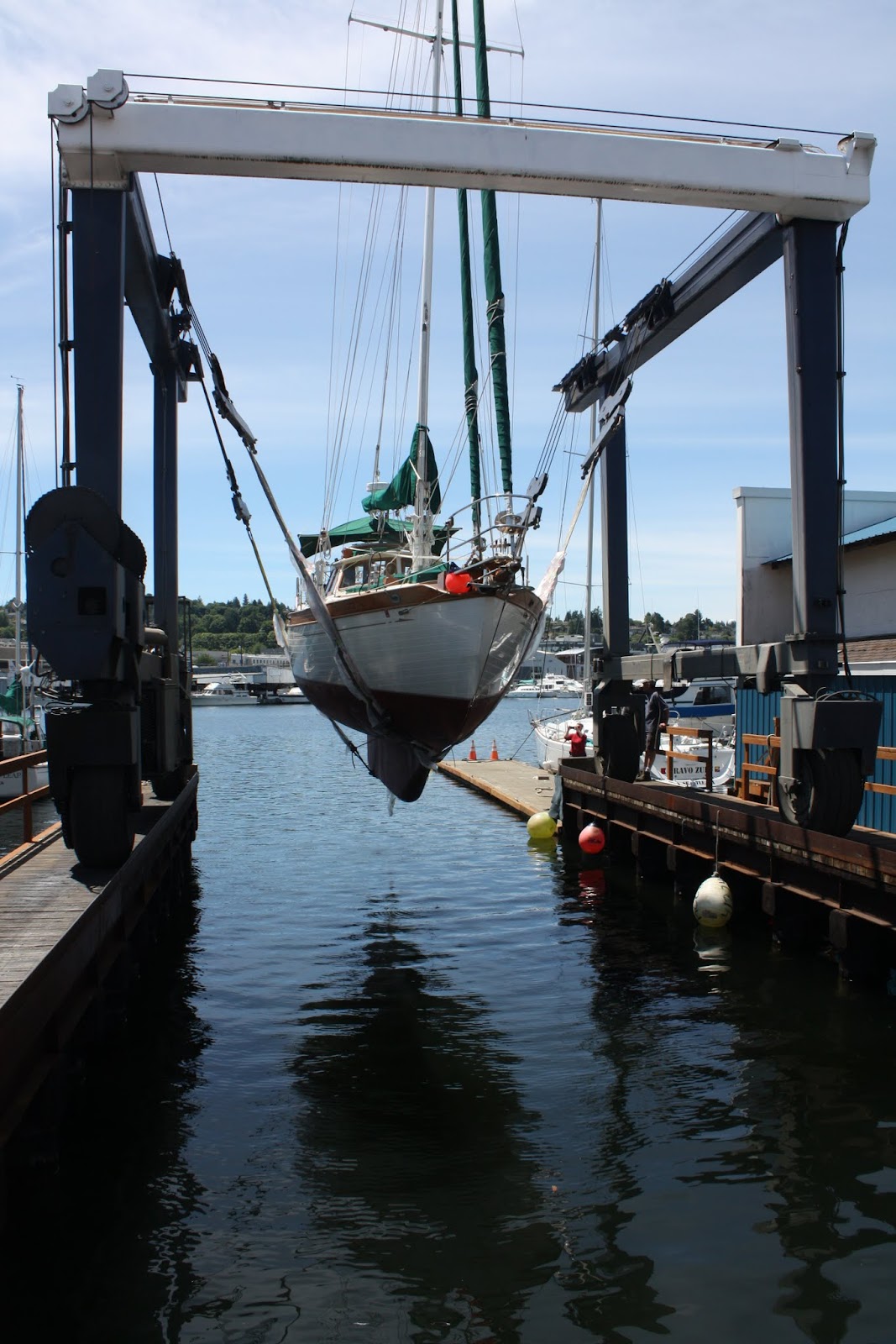
Brigadoon, on the hard, at CSR boatyard.


It's been quiet because we've been busy.  The new sails are settling in, though we have had little time to seriously exercise them during the normal Seattle Juneuary (cold, little wind, not fun cloudy days).  That's just fine though.  It allowed us to take Brigadoon out of the water for a planned haul out.

The haul out was to redo the bottom paint, inspect the cutlass bearing (that is the bearing that supports the prop shaft as it exits the hull) and rebuild the stuffing box (the thing that keeps all that water out of the boat where the prop shaft enters).

There was also the matter of our electronics/navigation instruments, or the lack thereof.  Brigadoon came equipped with a rather rudimentary set of instruments.  There was a 25 year old depth sounder, with nixie tube display (look it up -- they used this type of display on the Apollo missions).  The knot meter was funky.  We had no real wind instrumentation.  So we started researching putting new stuff on the boat.

We did a lot of research and had some mighty plans for Brigadoon, which we ended up scaling down as necessary.

As I look at the systems on Brigadoon and my plans on going places in this boat, I have thought a lot about systems that I have, which ones need an upgrade, which ones I need to obtain, and which I need to junk.

I mean, I could load the boat up with the latest in chartplotter/radar/AIS/VHF/depth/fishfinder/watermaker/inverter/tv/vcr/dvd/blueray/blender/mcrowave/hot tub/etc/etc/etc

I could spend a fortune loading the boat with gadgets. I could also have to quadruple my battery bank to support them. I could get ridiculous with it. Or not...

So I'm looking at what is really necessary, what can be re-purposed, what can be used for dual purposes. The thing is, as you add one capability, you have to take into account the infrastructure to support it and then, maybe those things need additional infrastructure, etc, etc, etc....

It can be a long and winding road of this thing, supporting that system, requiring an upgrade of another and pretty soon you are so surrounded by what you *have to have* to support something maybe you really didn't need in the first place.

I understand this is blasphemy the manufacturers out there, who want us to consume their "marine grade" pens, pencils, log books, and toasters that they are very very proud of -- just look at the co$t. Well, I don't have to buy all their stuff just because it is shiny and new, because it was reviewed in the latest issue of SAIL, or I think I have to keep up with the Joneses when at anchor.

So every purchase is backed up by some questions.

Do I really need this?

Can this capability I'm acquiring be done another way -- especially one that is less costly?

Do I need additional infrastructure to support the shiny new thing and, how much is that going to cost?

What are the unintended con$equences (costs) of the addional infrastructure?

With those thoughts in mind we decided to haul Brigadoon, take care of some maintenance, and do a few upgrades.

The first was the haul out and bottom paint at CSR boatyard.

She needs new bottom paint, bad.

The prop didn't look too good either and, there is no zinc here.
While she was out, we also decided to make use of her "dryness" to take care of a possible worn cutlass bearing, and replace the old stuffing box with new packing. 

The stuffing box in an antiquated thing; technology a century old. It consists of a bunch of flax rope, soaked in paraffin, that is stuffed into a "packing gland" around the prop shaft.  It is supposed to keep most of the water out of the boat while allowing just enough to lubricate the spinning prop shaft.  There is a newer version of this technology called a "dripless seal" but, when doing my research, I found that it's failure mode is a little too catastrophic for my tastes.  You see, when an old style stuffing box fails, you just get more water.  When a "dripless" fails, you get a whole lot more water -- gushing water.  I like simple technology that is easy to maintain and repair over more complex technology that you have to replace to fix.

Since we are caught in the "while she was out" phase, we decided to have her hull polished too.  And this is what we got...

New bottom paint and polished hull.  
New paint, pretty as can be.
CSR did an excellent job with the bottom paint, repacking the stuffing box and polishing the topsides of the hull.  We are very happy with their work.

I will never be comfortable watching my eleven ton boat being hauled around like this.  I know they don't drop them but...
And they put her in the water nice and gentle.

We also decided to have this haul out allow us to replace her depth sounder and knot meter.  This was a perfect time to upgrade her navigation instruments.


This meant we could go with an all-new NMEA-2000 network on the boat.  This is extremely simple and useful.  The backbone powers all the instruments.  It allows every single NMEA compatible sensor, computer, instrument, antenna, to talk to each other and share information.


So we decided to go with the backbone, a new GPS antenna (hidden under the deck), new masthead instruments, depth sounder, knot meter, water temperature, air temperature, barometric pressure, wind speed, wind direction, three displays, and an interface to our laptop, which contains our navigation software.


All this was installed by Yacht Masters, which is located right near the boat.  They did an excellent job.  We are very happy with their work.


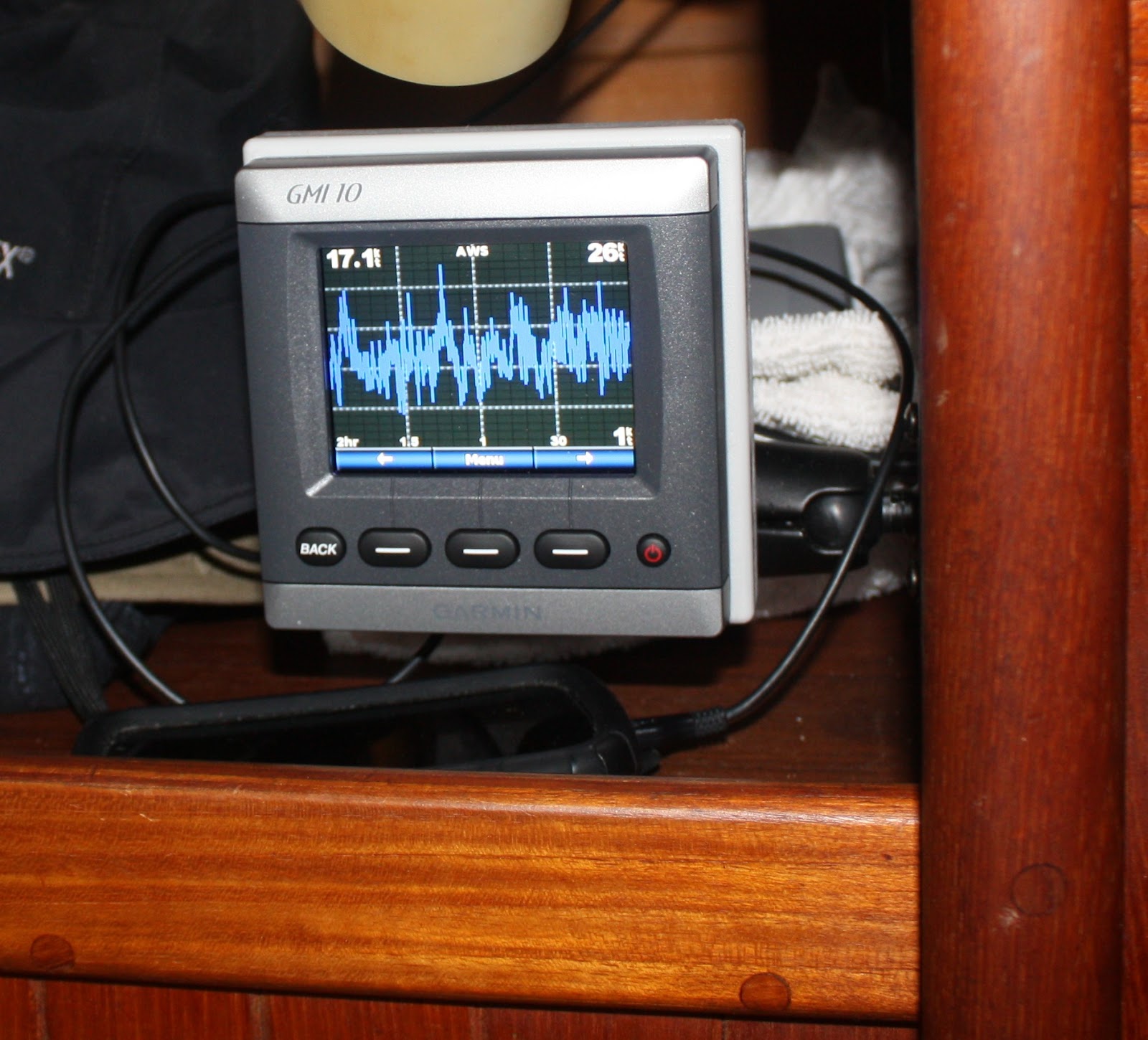
We have data!
In graph form too.

And one next to my bunk too so we can monitor the boat at anchor.
There is also a GMI 10 at the wheel in the cockpit.  It's great being able to display any data we want, at any location, and on the laptop too.  


This was a big bunch of maintenance and upgrades for us.  There is no doubt out capabilities are greatly enhanced.  They were well worth doing.


Now it's on to much smaller, less expensive projects, and to get some sailing time in this summer -- it's on August 22nd and 23rd, right?


Sunday, May 20, 2012

A night at Blakely Harbor

Brigadoon at Blakely, looking east towards
Seattle.
It was our first outing on the Sound since August of last year.  We have since purchased a new anchor, and a new set of sails for Brigadoon.

The plan was to get under two drawbridges and the locks early Saturday morning, make it out on to the sound with forecasts of very light and variable winds.

We didn't forget how to lock-through and were soon headed out of the channel into the Sound.  The forecast was right.  The winds were light to non-existent.  However, we raised sails anyway and made a go of it.  I didn't buy a sailboat to motor everywhere.

Sure, we only saw 1.2 to 2 knots on the GPS and a baby can crawl that fast but, we were sailing along, headed southwest towards Blakely Rock and the entrance to Blakely Harbor, sitting in the sun, quietly enjoying the Sound.

It took all day but, we made it and, when we arrived, my friend Kim offered his mooring ball and dinner.  We didn't get to use our new anchor *again*, but we did have an evening of great company, conversation and an awesome dinner; not to mention the Blakely Harbor water taxi, courtesy of Kim.

Feliz the harbor seal (apparently they are all called Felix) visited the boat frequently, stopping by the peek at us from time to time.

Blakely Harbor is an amazing place. It's very protected, very quiet peaceful.  That's a big change from it's past as the largest lumber processing facility in the world.


We even got to use the new yacht lamp our friends Greg and Sarah gifted us with a few months ago.

It's warm glow illuminated our cabin as we bobbed quietly on the mooring ball in the middle of the harbor.  At the dock we have almost constant little waves and rocking from the passing boats.  Here, it's like sleeping on a still cloud; quiet, serene and beautiful.  We awoke to grey skies and a typical light drizzle.

We motored back home, taking the opportunity to practice our radar and nav skills.

We'll be returning to Blakely as often as we can.


Monday, April 9, 2012

Navigation Hazards

We had planned out first overnight anchor-out trip last weekend.  


There are some lessons to be learned here for me.

I have a call into the construction crew for the 520 Bridge replacement project to discuss their nautical warning and safety measures around this project.  I also have an observation about boater doucebaggery.


This project entails placing new mooring anchors next to the existing bridge, then floating new bridge sections into place.  The project should complete in 2014.  They have also changed the opening rules for the center span.  I read the site and didn't see anything specific about blocked channels.  

We were headed out of Lake Union towards Andrews Bay for an overnight on the hook and to check out our new Ultra anchor.


This was the intended route.

As we approached the east end of 520, there were indeed two large barges just west of the channel.  We read all the signs.  None of them seemed relevant to us.

I approached a few hundred yards north of the barges and determined that the channel seemed open.

I did note what seemed to be to be a large number than usual of the "no wake" type of notification bouys in the channel.  (that would be a clue)

I approached the east channel entrance, noting the lake level at 64 feet at the east side of the channel.  I determined we had bridge clearance and proceeded at about 4kts.

There was a small motor boat stopped directly in the channel under the bridge.  I could not determine what they were doing and they were not moving.  I sounded five quick blasts on my horn, letting them know they were a hazard to my transiting the channel.  They moved out of the channel and back north into the lake.

We then proceeded into the channel, only to find the "no wake" bouys were indeed, "Channel Blocked" bouys.

Fortunately, I was able to back Brigadoon away from the bouys, even though she drifted into one of them a little and were blown pretty close to the bridge towers by the north wind.  We were able to get out of the channel and return to north into the lake.  

As we left, we checked again and saw no indication whatsoever on the barges that warned that the channel was blocked.  In other words, you have be right on top of what you think are "no wake" bouys before you see they are "channel blocked" bouys.

Lessons learned (that means, "my fault"):

Lesson 1: It did not occur to me to do some research to see if there were any navigation issues surrounding this project.  I figured that I'd check it out and assess the situation when I arrived -- wait for Lesson 2 in a bit.
Lesson 2: I should have used my binoculars to assess the situation before I entered it.
Lesson 3: I ensured I told another approaching sailboat that they channel was marked as blocked.
Lesson 4: Other sailors may not do so, as the motorboat demonstrated.

Like I said, I have a call into the construction office for this project.  It is my opinion that they do not have the channel marked properly.  I'll see if they are willing to do a little more so a boat will not be placed in a hazardous situation, trying to back out of the somewhat narrow channel.

So, next trip south, I'm making them open the 520 bridge for little ol' me.

Wednesday, March 7, 2012

How to buy a new mainsail -- step one, buy a new car.

We have have had plans for new sails for Brigadoon for a while.  Back in August of 2011, we visited Port Townsend, where our friends were having their boat measured for new sails.  I've always loved the thought of having my sails made by Carol Hasse and her crew at Port Townsend Sails.  Sure, you can get good sails at a lower price but, as I have written before, the thought of supporting a local business, putting my money here, in this country, while having my sails made here, in one place, really appealed to me.

The fact that Carol Hasse makes some of the best cruising sails in the world was just icing on the cake.

So we walked into her place back in August.  After a bit of a tour, we agreed to get a quote.  It wasn't cheap but, we could make the plan work and, with that, we put down our deposit.  A personal visit by Carol a short while later for the measurement, some back and forth on when the sails would be made, and we had a schedule.

The plan was to have the sails (mainsail, staysail, and genoa) made in stages.  This way we could pay cash for each sail.  It was important to us to not buy our sails on credit.  This worked out great.

So the main came due.  Since the sail is a full batten main, it can't be folded up into a small package.  It's in a fifteen foot long bag o'sail.  This presented a problem.  We have a small car.  We call her Smarty.


Smarty is only nine feet long. Smarty has no roof rack, nor any way of mounting one.  While Smarty always wins the parking lottery in Seattle, she has only two seats and a limited cargo carrying capacity.  But, we have had her for two years and like her for many reasons.  She's fun to drive, and you can enjoy roaring around town while people point, smile (sometimes laugh) at the car.  However, as I mentioned, Smarty has no roof rack.

So the plan was to get a Zipcar, specifically a Ford Escape with a roof rack.  I was going to lash a 19' long windsurfer mast to the rack and the sail bag to that.

We wake up Saturday morning to a nail in the rear tire of Smarty.  This requires a trip to the dealer for a repair as Smarty has odd tires and my warranty is with the dealer.  I get there and the dealer is not open for about 45 minutes.  This frustrates me.  I ask the kindly Acura employee if we can get some coffee in their shop next door while we wait.

So, step one to getting a new mainsail for Brigadoon involved getting a new car.


Witness the new Acura TSX Special Edition.  Smarty is on to a new home and we have a new ride, with a roof rack, that compares favorably with my old BMW Z4 in performance and comfort.  I think we will be very happy with it.  

Today we finished installing the Strongtrack on the mast for the new sail, along with completing a rig tune.  There is still some fine tuning to do on the rig (the mast has a small "wiggle" in it) but we were ready to go, so, time to bend on the new main.

And here it is: a Carol Hasse designed and Port Townsend Sails built, cruising mainsail, complete with deep reefing, cunningnam, full battens and a host of other really awesome hand done features.


I'm so far, very happy with how absolutely beautiful this sail is. It fits the boat wonderfully.  I bet it sails as well too.

In a month, we get the genoa, then June the staysail.

I can't wait to see how well Brigadoon performs with the new suit of sails.


Thursday, March 1, 2012

Hold fast...the religion of anchor selection.


How much would you pay for having the best anchor in the world? 


How much is a night of sleep at anchor worth to you?


How much would you be willing to pay, right now, to be held fast to the sea bottom, as your anchor is slipping in the middle of the night?


Those are all reasonable questions and well worth considering if you are on a cruising boat.  With that in mind we came across a variation of a new type (spade) anchor at the Seattle Boat Show.  We weren't planning on buying a new anchor at the time.  I had thought about it a little but, ruminations on anchors are different than actually purchasing one.


There are about as many opinions on what makes a good anchor as there are opinions on religions or politics.  This is so much so that almost any discussion of anchors and anchoring (a fine art in an of itself) can quickly devolve into statements that are hard to distinguish between opinion and fact.  People feel pretty passionate about their choices of anchors and how they use them.  Anything that questions that world-view can be challenging to whoever is the current *expert* expounding on the *right way* to anchor and which is the *right anchor* to use.


I don't have any specific religious beliefs when it comes to how things work.  I'm willing to have my techniques questioned by others, as long as the questions aren't loaded with the speaker's assumptions or accusations.  Who knows?  I might learn something and it might make a difference in my capabilities, the safety of my boat and the persons aboard?


The simple fact is there is no single anchor for every possible situation. Everything is a compromise.  What you do is ensure your boat has the right combination of ground tackle to handle most situations that you expect to encounter.


It was with that thought in mind that I started examining our anchoring capabilities.  Brigadoon's ground tackle consisted of three options.


There were two CQR anchors on the bow: a 45lb primary with a 35lb secondary.


The stern holds a lighter Danforth which can be used for stern anchoring or for dual anchoring.
The CQR is a fine anchor, with few drawbacks.  My 45lb CQR once held two other boats rafted to Brigadoon (that's 47,000lbs total) in about 10-15 knots of breeze.  It can also lift a six foot long stump from the bottom too, but that's another story.


My anchor gear was satisfactory.  I had the right amounts of chain and nylon rode.  I thought it performed pretty well.  So, why consider a better anchor?  Wasn't the CQR good enough?


The CQR does have one failing.  It can sometimes drag along a bottom, on it's side and not set. It can also do this if it is pulled out and tries to reset. Spade anchors tend to set quicker, deeper and if pulled out, reset again.  


With that improvement, I considered two spade anchors that received good reviews. 


The Manson Supreme and the Original Rocna.  They are similar in design. The Rocna is called the original.  This is for a reason. They are in close competition, with the usual back and forth between companies that can happen.  "He stole my design."  "I simply improved on it."  You know the drill.


Either anchor can be superior to a CQR.  The bail (the curved ring) encourages the anchor to turn and dig in. The spade has good holding power.  There are some other subtle differences but, when it comes down to it, they are very similar and both good.


However there is an alternative.  It's the one we chose.  The Ultra Anchor.


Ultra Anchor Web Site

Yeah, it's shiny and pretty and all but, that wasn't the reason we made this decision.


What were the reasons?
  1. It has no bail.  
  2. The bail is supposed to help right the anchor so it digs in.  It doesn't need a bail because the center of gravity, thanks to the lead filled tip, helps the anchor turn it's spade down.  
  3. The bail also makes it harder to stow in many anchor rollers.  
  4. The bail also can inhibit the anchor's ability to dig in and stay dug in.  It can lever the anchor out of the bottom.
  5. The shank is a hollow tube, instead of a flat piece of steel. This should make it stronger for a given weight and helps the center of gravity be concentrated in the spade: see point #1
  6. In my own tests, in the test beds at the show, it performed better than the scale model Manson and Rocna anchors.
We saw the Ultra at the boat show.  They have a demo booth where they compare scaled down versions of different anchors.  They place the scale versions in two large tubs, one filled with fine sand and the other gravel.  I carefully tried different anchors, ignoring sales pitch and seeing for myself the performance of this anchor compared to the Manson, Rocna and the CQR I currently have.  In ever test I saw, every one I tried, even tests they didn't show me, the Ultra set very fast, stayed buried, even when spun around 360 degrees and reset when pulled out.  I was pretty impressed.  But I wasn't ready to buy. It was expensive, almost prohibitively so.  I went home and did some research on-line.  I watched various videos of it performing under water on various boats and bottoms.  I read testimonials.  I read a lot.  The only thing I read that made me pause was the cost. 


Knowing that they were having a deal for the show, and knowing what my budget was, I returned to the show.  One demo model they had, the one I planned to buy, had been purchased just an hour before.  So there I was, with my cash in my pocket and no anchor to buy. 
I looked chest fallen. The salesman told me the new model in my size was at a price that I simply wasn't willing to spend at that time.  So I pouted a little, looking lost, having all this money in my pocket.  He went and talked to his boss.


Ten minutes later, with some hand-wringing on the part of the owner, I got the 46lb model I wanted for the money I had.  I saved literally *hundreds* of dollars.


Later, when I returned to the show, they cut me a deal on a shackle that allows the anchor to self-right when being pulled into the pulpit, and reduces the chance of the anchor pulling out when deployed due to the boat swinging in the wind.


So I brought it home and installed it aboard.  I removed the 35lb CQR and sold it quickly to the first buyer who called.  I moved the 45lb CQR to my secondary anchor position and placed my brand new 46lb Ultra in it's place. 

And here it is.


It fits pretty well next to the bowsprit and under the stays.  We are looking forward to trying it out on our anchoring adventures this spring and summer.


This just might contribute to a better nights sleep at anchor. 


If it does, it will be worth every dollar we spent.