Showing posts with label self-sufficiency. Show all posts

Monday, December 30, 2019

Leaving Home and Arriving Home

We had spent a month cruising South Puget Sound, getting ready for the departure we've talked about, planned about, worried about, checking our boat and ourselves out for the 830 nm journey from Port Townsend to San Francisco. The month was time well spent discovering and fixing problems with things like solar panels (broken wire fixed at anchor), getting used to the navigation software and to the pace and rhythm of traveling again.

I was focused on the safety and seaworthiness of Brigadoon and the care and feeding of her crew. We'd agreed to take a friend along on the offshore  journey -- Patrick had called us and wanted an adventure. He'd never been offshore on a sailboat before.

Patrick, Donn, and Kerry at Siren's in Port Townsend
Our charting and weather software estimated our voyage to be approximately five days.

We left Port Townsend on Thursday morning, September 5th at 11am.  It took 11.5 days, with stops in Port Angeles, Neah Bay and Crescent City, California.

This was to prove our most challenging journey to date.

The trip to Port Angeles was calm and uneventful.  A nice quiet start.  Kerry waved goodbye to her parents as we passed the Point Wilson lighthouse.  The three of us walked into town and enjoyed a nice Italian dinner that evening and went to bed early to be ready to fuel up and leave for Neah Bay the next morning.

An hour out of Port Angeles, the wind was on our nose, we became enveloped in thick fog and the waters started to churn.  We then slowly inched our way to Neah Bay in increasingly foul conditions.  Kerry had to put on the patch and struggled with seasickness.  It took us 14 hours to get to Neah Bay that day.  We entered the unfamiliar harbor in quieter conditions, but at night.  Kerry used our powerful flashlight beam to find our slip as we slowly motored in.  We stayed for two nights so we could rest up.  I changed the oil, discovered our impeller belt needed to be replaced, and made sure everything was in order.

We departed Neah Bay in pea-soup thick fog and motored out the Strait and into the Pacific. Facing calm conditions, and a fog that slowly burned away under the sun, our course took us farther and farther west until we were 100nm offshore. This was to avoid the rougher waters common along the Washington and Oregon Coast and to give us some experience being really out there.

That was an odd part -- the world -- the land -- just going away.

Kerry and I shared the watch schedule - at night, 3 hours on, 3 hours off.  During the day, we played with 4 on and 2 off.  It seemed to work pretty well.  Patrick helped by keeping us company when he was up and doing the lion's share of the cooking and dishes.  Based on our experience on this trip, I know Kerry and I can do this alone when we do our next longer voyage.

First Sunset at sea - September 8, 2019
 And there was no wind, or not enough wind. All the forecasts we studied showed winds of 15-20kts. This would have been perfect for Brigadoon but the winds weren't 15-20kts.  They were more like 6-8kts.

Combine this with the 2-3 meter swells that made sailing well nigh impossible. There wasn't enough wind to keep the sails full and powered up as the swells caused Brigadoon to roll enough to slat the sails and make them useless.

Then there was me, rigging the Asym sail backwards...you'd think I'd learn...

There's always something to learn, some new challenge to figure out while underway. This trip was going to be about engine and fuel management.

Ironically - Kerry and I both used the patch on this trip and Patrick didn't suffer from any discomfort at sea at all.

We were 100nm north of Crescent City when our calculations made it clear that we wouldn't have enough fuel to make it to San Francisco with an adaquate reserve. So, we decided to divert to Crescent City for fuel.

We stayed in Crescent City for two nights also.  Again - rest was needed at this point.  I changed the oil again, we did laundry, took showers, rested.

The final leg to SF was similar -- strong rollers and little wind. Our 4000hr Yanmar engine pushed us along at 5 kts and a quiet(er) 2100 rpm than our usual 2600 rpm. All I had to do was check and top up the engine oil every 24 hours and ensure the fuel filters were flowing and we were good to go.

We spent the last day along the California coast planning our entrance to the Golden Gate and San Francisco Bay. Various guides warned about traffic and current challenges entering the bay. They all cautioned against rounding Point Bonita and crossing under the gate during an ebb tide -- something about heavy currents and rough water (seen this before many times in the Puget Sound).

So we slowed a little and, instead of sailing under the Golden Gate on a beautiful sunset, we had to wait and enter at about 9:30 PM. The ebb was down to about 1.5 kts and I knew we could handle that. It was a rough and bouncy ride anyway, around that point, but as soon as we turned in towards the bridge the point shielded us from the two meter swells that were banging against that current. After I stood at the wheel for over an hour, riding Brigadoon like she was an angry horse trying to toss me off, we finally approached the bridge.

And there we were, crossing under the Golden Gate.

The bay was calm and beautiful as we motored past the Golden Gate, past Fisherman's Wharf and the city, past Treasure Island and under the Bay Bridge and finally into our slip at 11:30 PM.

That was hard. We were beat.

We covered 822 nautical miles in 11 days, with four days at the dock, and 179 hours of motoring that engine.

Alameda is nice. We have a home for a while.

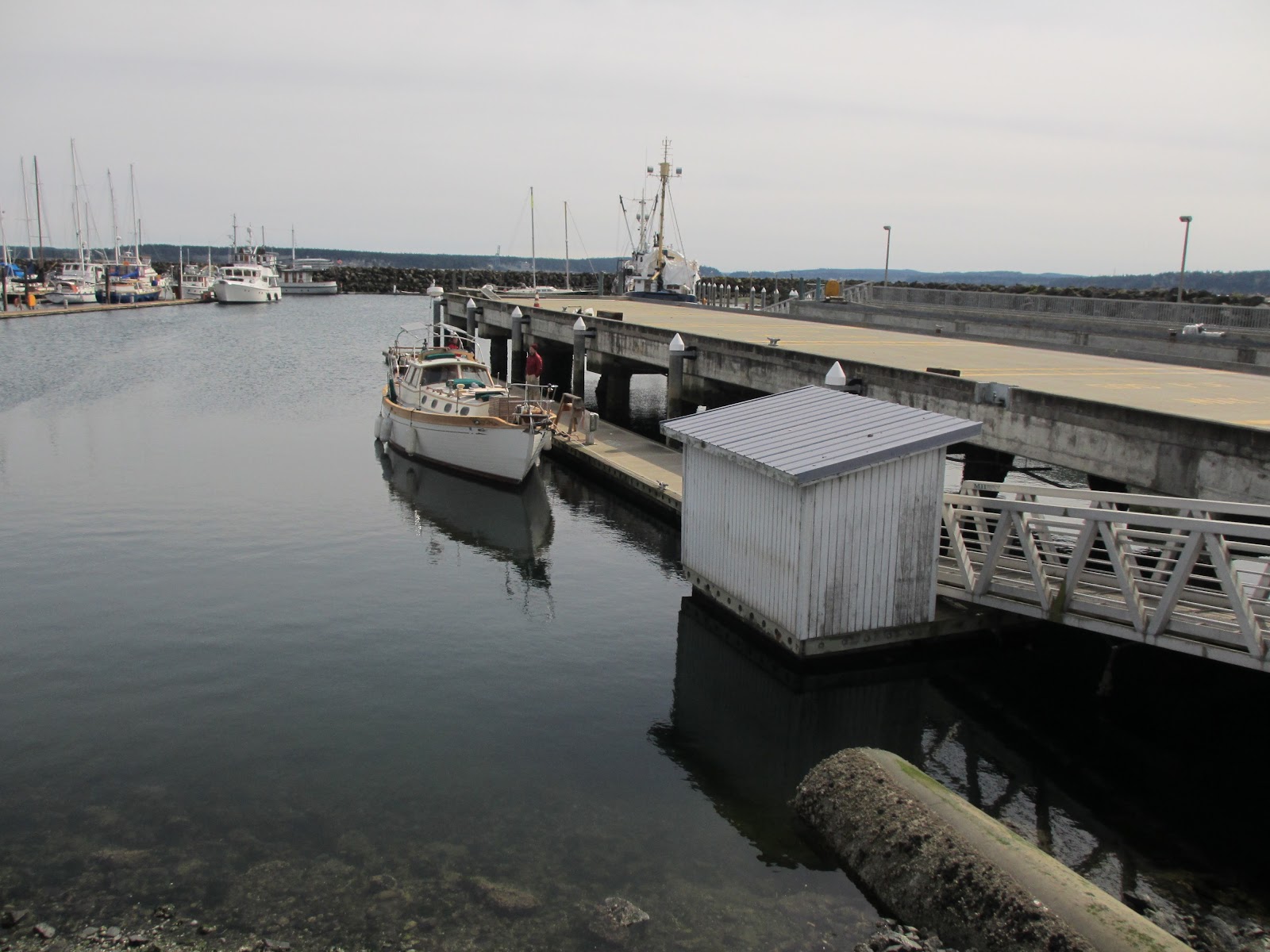
Brigadoon in her slip in Alameda - September 17, 2019


Friday, July 7, 2017

The "Outer Passage"

Written by: Kerry
TWO roads diverged in a yellow wood,
And sorry I could not travel both
And be one traveler, long I stood
And looked down one as far as I could
To where it bent in the undergrowth;        
Then took the other, as just as fair,
And having perhaps the better claim,
Because it was grassy and wanted wear;
Though as for that the passing there
Had worn them really about the same,        
And both that morning equally lay
In leaves no step had trodden black.
Oh, I kept the first for another day!
Yet knowing how way leads on to way,
I doubted if I should ever come back.       
I shall be telling this with a sigh
Somewhere ages and ages hence:
Two roads diverged in a wood, and I—
I took the one less traveled by,
And that has made all the difference.

- Robert Frost (The Road Not Taken) 1920

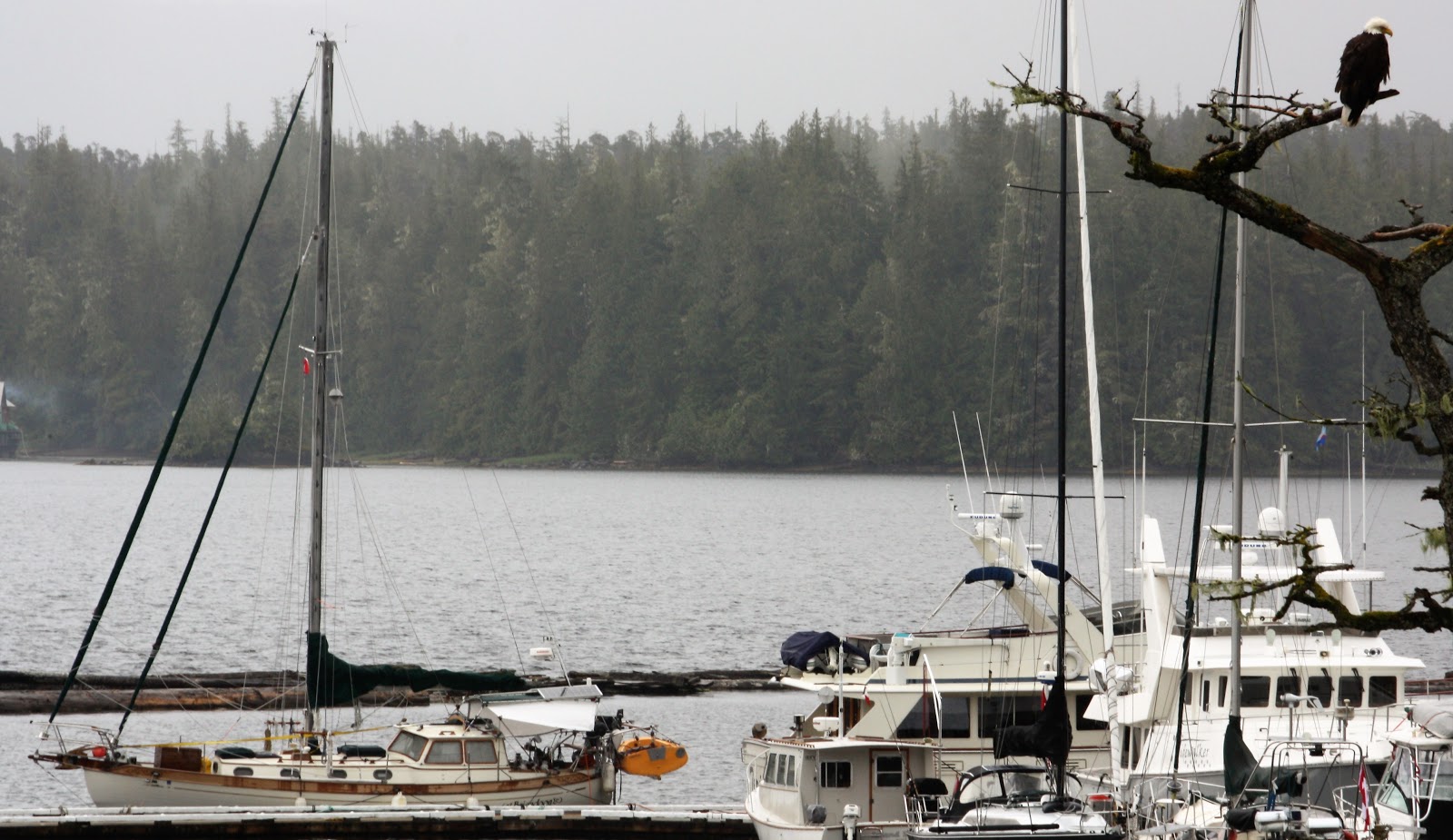
Brigadoon at the dock in Shearwater, BC, with bald eagle.

We left Shearwater on Saturday, June 24th, having done lots of research about our next leg of the trip that would bring us up to Prince Rupert, the typical jumping off point for Alaskan waters.  We had expected to plan and take the more inside route, also known as the "Inside Passage", which follows more protected waters and is used by the BC ferries, many cruise ships, tugs, and most cruisers.  We looked it over closely and weren't majorly impressed with the choice of anchorages - both for distance between them and for depths.  I have no doubt the passages are beautiful and protected, but then we started to look at other options...


From Seaforth Channel into Milbanke Sound, we looked at how to get around Price Island and continue north without going up to Klemtu and the inside waters.  We decided to go to Louisa Cove for our first night out to see what Milbanke was like and make our final decisions on which direction to go, with the primary thought to continue on to Aristazabal Island the following day assuming we weren't too freaked out by the more open water.  Well if you look at the lowest black dot on the map above, that is Louisa Cove - and you'll notice we didn't stop there at all.  Here's what happened...

We were cruising out of Seaforth Channel and I casually brought up the idea of not stopping at Louisa at all, but going straight on to our first anchorage at Aristazabal, Wheeteeam Bay.  Donn pondered that and told me he'd think about it.  It seemed like a beautiful day and the conditions seemed mellow enough to try, so we continued to talk about it and as we broke out into Milbanke, we adjusted the route on the chart and steamed through to Wheeteeam.  The most remarkable moment of that day's journey was going through Catala Passage at the bottom of Price Island.  It's usually more protected waters and gives one a slight shortcut through to Laredo Sound.


  As you can see above, it also requires careful navigation around many islets and rocks.  We were both on point watching our way as we motored through.  It was stunning scenery, almost ghostly with mists and rock formations all around us.  Unfortunately no photos were taken, as we were so focused on staying safe...

Instead of a 4-5 hour day, we had about a 10 hour day when all was said and done, but we had left early and arrived with plenty of daylight remaining, finding a beautiful place to anchor.  We ended up staying there for 2 nights to give ourselves time to recover and also explore the beautiful bay with its endless coves and inlets.  It was truly stunning.

Low tidal flat in Wheeteeam Bay


When we left Wheeteeam Bay we continued our way north with the next target anchorage at the top of Aristazabal Island - Tate Cove in Borrowman Bay.  This stop ended up being one of our most rewarding and fun of the entire trip.  We arrived on a Monday afternoon and stayed until Thursday morning to wait out strong forecast winds.

Monday evening, as another boat pulled in and anchored near us, we realized we were looking at another Baba - little sister to our boat - a Baba 30.  The best part though?  Their boat's name was "Camelot".  Two Babas in the same cove is good enough, but two Babas with names like "Brigadoon" and "Camelot"?  How awesome is that???   Two boats named after mythical places, both told as musicals. I didn't stop giggling about it all week.

Camelot - Doug and John on their way to Haida Gwaii to meet up with their wives
On Tuesday, we went nosing about in the dinghy...  The cove next to us had a huge floating fishing lodge set up on a barge with multiple ties to shore and dock space for a small sport fishing fleet.  As we came close, they (nicely) warned us away from their dock, as they were expecting a helicopter landing any minute.  We dutifully left and did not return to bother them.  However, as we were leaving, another skiff with a driver and a black dog in the bow came up to us and invited us over to stretch out legs later if we wanted.  It was then we realized there was ANOTHER floating structure behind the lodge.  This turned out to be the home of Rick and Jeanne Beaver and their dog, Skipper.

Home of Rick and Jeanne Beaver
They are a retired couple who started creating this little floating homestead about 14 years ago.  They live here year round and use everything around them - most of their docks and structures were all built from found wood drifted up on the beach.  They create art and tend gardens in boxes and a little green house in back.  The little wood hut at the far left is a wood fired hot tub.  They welcomed us with open arms and a bit later Doug and John from "Camelot" showed up in their kayaks and we all hung out for awhile.  Jeanne and I had a great time sharing stories and getting to know each other while the guys all checked out Rick's various projects outside.  When it came time to head back to the boat, Jeanne piped up and said "Hey! Let's all get together tomorrow evening for a potluck!"  We all loved the idea, decided what we would each bring and bid adieu with promises of more fun the next day.

I spent the next day reading and relaxing on the boat.  Donn went for a hike on his own and then later got picked up by Rick in his skiff with the other two guys (and Skipper) and taken on a tour of the nearby islets and beaches (I stayed behind because I was enjoying my book too much).  We all convened around 6pm and had a lovely evening in the Beavers' home.  I convinced Donn to bring his guitar to entertain after dinner and it was a huge hit.  They loved his music and even suggested he check with a local hotel lounge in Prince Rupert about playing there when we arrived.  It was hard to say goodbye - but we decided we could easily stop there again on the way home - so we hope to see them again soon.

One of Jeanne's gardens, with Skipper in the background
Doug, John, Me, Donn, Jeanne, and Rick

We had plotted out our next stops between Aristazabal Island and Prince Rupert and each one went as planned.  We stayed a night in Weinberg Inlet on Campania Island, which was stunning.

Mount Pender on Campania Island
Then we stayed two nights in Patterson Inlet on Pitt Island due to heavy rain.  We woke up the first morning, knowing we had planned to leave around 10 or 11am.  We listened from our bunk as the rain poured down onto the deck and looked at each other and decided we could afford another day in this beautiful place and not brave the rain just yet.

We left Patterson and headed for Newcombe Harbour inside of Petrel channel, out last stop before a long day to Prince Rupert.  We enjoyed a little sailing that day, although the winds were light.  As we rounded into the channel for Newcombe Harbour, the winds picked up, with rain threatening to douse us.  Donn got two photos as we headed in...


Bald Eagle flying off a perch inside Newcombe Harbour
Newcombe Harbour was tricky, as our ideal anchorage depth was located in a trough in the middle of shallow mud flats.  Water covered it all, so except for our charting software, we had no idea of where those shallows started.  I inched our way in and watched the depth sounder.  As I got a little too close for comfort, I started to turn up into the wind to find a good spot and saw depths as low as 13 feet cross beneath us.  We safely anchored in about 34 feet a little ways out as a huge gust of wind blew us sideways hard, setting our anchor perfectly with the rain letting loose on us all at the same time.  As the rain died down that evening, Donn noted that he could hear multiple rivers and waterfalls around us as we sat there in the middle of the little bay.  This is another spot we hope to visit on our way back, hopefully with nicer weather.

Our final leg to Prince Rupert was about 10 hours - we left at 4:30am to catch Petrel Narrows at low water slack and everything was smooth as we glided through.  I sat in the bow to watch for logs in the early morning light and marveled at the beautiful scenery around us.  Simply gorgeous and so humbling.  We both remarked how happy we were to have taken the outer passage.  We barely saw any other boat traffic under way and never shared an anchorage with more than 1-2 boats.  The conditions were benign, we barely had enough wind to sail, and only did so about 1/4 of the way.  As we plan our return, we'll take this option again - no doubt in our minds.

Tuesday, April 11, 2017

We Have a Mast

It's been a long road, with tons of sanding disks, rivets, taps, machine screws, tape, Lanacote and some blood here and there. After all that, today, the stick went in. We have a mast.

Photos courtesy of :Ray Zebas

Thanks to Anders and Jeff of PT Shipwright's Co-Op and Gus the crane guy.

Oh, and Kerry, my dedicated and hard working First Mate.

The day started out calm and promising.

Brigadoon lay ready for her mast.

Gus the crane operator arrives as promised, making us very happy, after we have to cancel yesterday. He did some quick schedule juggling yesterday and wrote a check of hope he cashed today. It was great to see him arrive early.

And here comes the mast, for the second time in as many days.

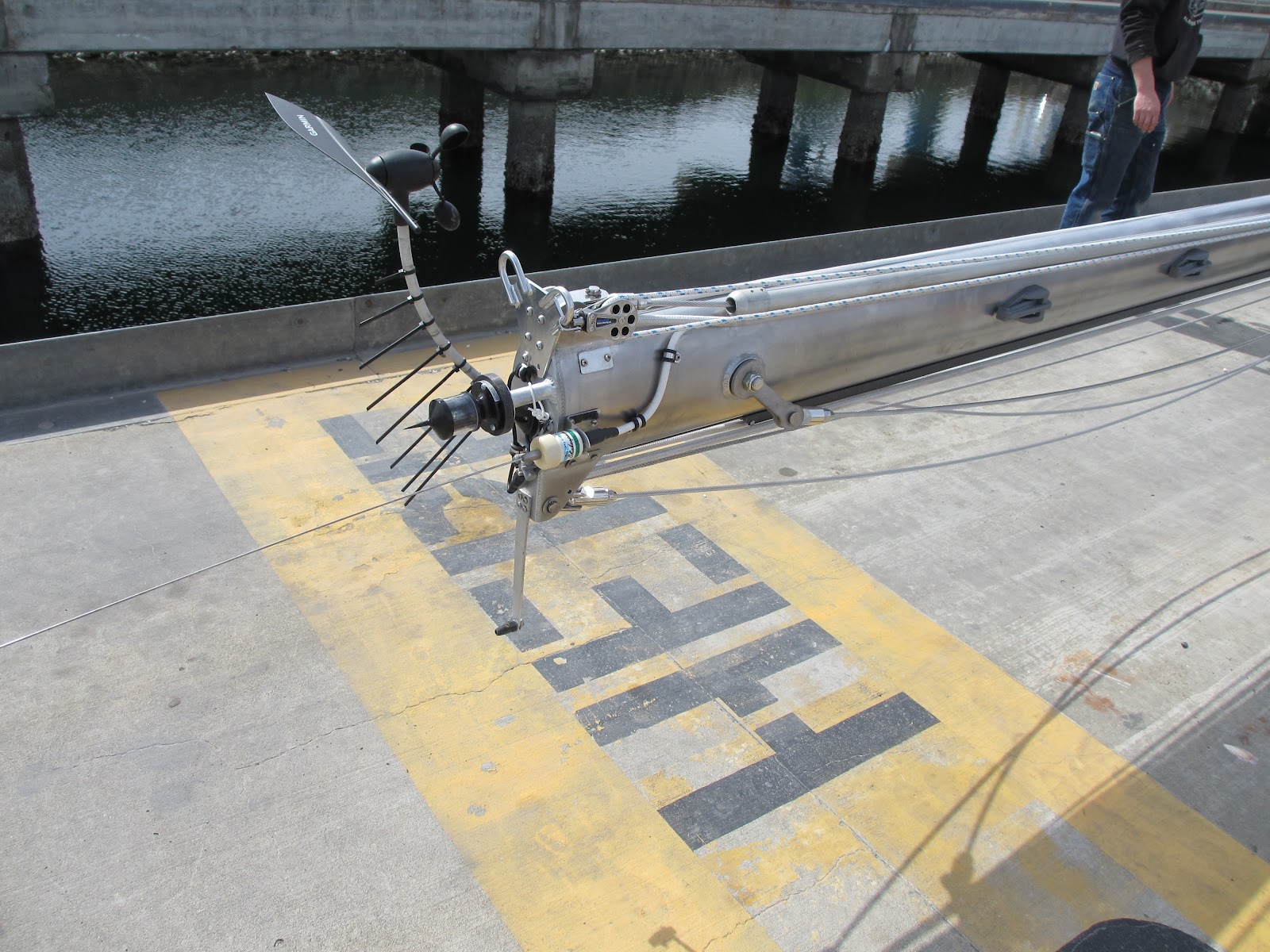
Masthead, with anti-bird Mohawk.


All wrapped up nice and safe.


Gus, the crane operator, rigging our mast while some guy who I have no idea who he is, tries to stuff a check at Gus. I was too busy to whip out my, "do you mind waiting just a moment and not distract my crane operator while he is rigging my job," speech. I still puzzle at it, looking at this photo.


Check guy goes away, the spar is rigged and up she goes.


Some very careful walking to Anders and Jeff...

Kerry hands it back to Jeff, who came down to the boat...

And we get ready to lower the spar.

Kerry clears the electrical, which has to feed down first.


Anders and Jeff, making sure it's right.


At this point the spar is mostly in the boat.

The unskilled help is sent below to catch the mast.

After some wiggling, the spar slipped onto the step.

Furlers are installed.


The smooth as glass marina made this job much easier. It would have been very difficult yesterday.


And there she is, with her spar standing and rigging good and snug.

Friday, March 10, 2017

Knowing

Just dropping by for a quick update. I'll be posting more when I have time. 

Since Jan 18, we have completed all hull related stuff like:
  • Re-engineered and rebuilt rudder shaft.
  • Pulled, inspected and replaced perfectly good propshaft, with the proclamation from the prop guy that the yanmar was perfectly aligned. 
  • New bronze chainplates and re-engineered G-10 bases and covers over butyl.
  • New glass in the port holes, which included sandblasting the ports, installing the glass wrong, taking it all apart, installing the glass and seals right -- Kerry was also a trooper on this job. She did all the cleaning and prep and it was awful, including the second time.
  • New padeyes in the forward deck -- bedded to raised G-10 pads to get clear of the teak.
  • Rebuilt the anchor windlass (cleaned it and lubed it, basically) saving us the cost of a new one.
  • Cleaned water tanks (awful job -- Kerry handled it like a pro)
  • Divided the anchor locker and installed new spurling pipe from PT Foundry.
  • Solar is ready to go now that the mounts are complete.
  • Hydrovane unit is installed and aligned. We still need to sea trial.
  • Honda generator is on line.
  • Watermaker purchased and here.
  • Iridium go purchased and here.
  • AIS purchased -- still needs install.
  • Honda outboard on Monday.
  • Anchor chain goes all new both rodes on Monday.
  • Oh yeah, fix the Dickenson stovepipe.
  • and more.
Mostly though, after all that was done, there was still the rig. The 30 year old spar was looking pretty rough. Should I paint it? Do we have the time and money. No, aluminum is pretty tough. If you isolate it from other metals correctly, its outer layer of aluminum oxide will protect it better than any paint. Bare mast it is then.

After six hours of sanding, one side.


So I spent the last 40-50 hours sanding 55 feet of mast, turning a faded white, scuffed spar into a nice shiny spar. This included welded aluminum bodywork and everything. It looks awesome. I never want to sand a mast again but, this was so worth it for the finished product.

This was halfway though the process.
Polished and waxed.


And today, after weeks of taking stuff off the mast, I finally put something *on*. I punched the first rivet for the electrical race and the last rivet of the SS sail track that supports our strongtrack.

The last rivets for the sail track.

It was so satisfying, walking away from that mast at the end of the day, knowing the race is done, the sail track is done and we are ready to pull wire and build the standing rigging.

More to do and three weeks to go. My faith in this boat grows every day.

It's the Knowing. That's what all this is about. 

Knowing.

Saturday, March 4, 2017

Competence as a Travel Partner

Refitting Brigadoon over the last two months has become a whirlwind of plans, discoveries, revisions, and shifting priorities. We are on the last month with just weeks to go. The marching days keep our attention and intent forward – always forward. Every time we turn around, there’s something we haven’t expected, even though we expected a lot.

Our days have been filled with sanding, cleaning, generators, impact drivers, electric calking guns, anchor chains, outboards, wind vanes, tiller pilots, sand blasting, spreader lights, water makers, solar installation, bilge pumps, bedding port lights, sealing windows, cleaning water tanks, masthead lights, and more...

Rudder inspection became a complete reengineering of our rudder and quadrants. Chain plate inspections ended up being after the fact, as we decided that replacement chain plates were just the right thing to do. Reengineering the chain plate covers meant a sometimes-torturous learning process in how best to cut and shape epoxy-fiber materials. A curiosity about our anchor windlass encouraged us to take a chance and try the old “clean it and grease it and see if it works now” trick that I’ve used many times on old machinery over the years – it worked, saving us an easy grand. I spent days sanding and polishing a 30 year old mast so we could build it right. 

On an almost daily basis, I’ve dredged into my past, pulling up old skills, applying what I know, however I can, to solve the latest challenge and get us there. Thankfully, my personal toolkit is varied and broad; that’s been by design. I’ve never wanted to be the expert at one thing, instead content and satisfied to be good at many. Good, in this case, means competent. Eighty percent mastery is good enough, if it’s in enough disciplines. With it comes a surety, a knowing that problems are solvable. 

Why?

My whole life’s experience has brought me here, to this place and time, where the kid who loved science, art and adventure, who collected experiences instead of things, can grow up to do this.


As I told Kerry the other night, “This is the happiest I’ve ever been. I don’t belong anywhere else or with anyone else. I belong here, with you.”


Thursday, June 30, 2016

Slow the Fuck Down


There are times in your life when you just get in a groove, follow a path, chasing that goddamn ball to the exclusion of anything less important. I've been doing that ball chasing since February, working on a new novel and working on Brigadoon. I've made great progress in both arenas, with an additional benefit along the way; just slowing the fuck down.

Much of my work/life has been about performing -- and that meant agility and speed. As I progressed in my career I saw the speed tended to produce a lot of energy and a lot of 'fast failure' on a random track to success. People got hurt, either physically, emotionally, mentally or financially. Success, true success was rare, with mediocre accomplishments being touted as great things indeed. After that, it's time to rush off to the next initiative, burn up a lot of energy and time, and hope for the best. As I got older I started seeing more places for caution, maybe consideration before action, in a world surrounded by people who fix a mistake by doing the same thing again -- only faster, harder, and with more self promotion.

The last few months have really driven the lesson home of the work I can actually accomplish when I slow the fuck down. It's given me the time to think and consider the best use of my time. The projects don't move at a breakneck pace but, I'm finding I'm accomplishing much.

So far, I've completed the first draft of a 50,000 word novel. The next process is copy editing, design and self-publishing. We hope to have it out soon. Right behind that is another writing project - a collection of motorcycle articles I wrote between 2001 and 2005. There are three other writing projects behind that one.

I've also made progress in Brigadoon (pictures and more details coming soon):

  • Reconditioned the teak decks, leveling all calk and scrubbing well.
  • Stripped and reconditioned the teak on the cap rails, teak topsides, anchor platform, traveler arch, cockpit combing and cockpit sides. 
  • Managed a 2nd haul out, including bottom paint and new zincs
  • Managed an insurance-mandated valuation survey during the haul out.
  • Wrecked out the remains of the old head system, including the holding tank and all remaining hose.
  • Installed an ultra-sonic hull cleaning system, which included the head unit, installing four transducers to the hull and wiring back to the unit through countless bulkheads.
  • Cleaned the damn bilge.
  • Repaired a cooling system leak -- tracing it to chafed heat exchange hoses with the old water heater, which was leaking fresh water...
  • Removed and replaced the 6gal water heater, which included redesigning the water manifold to make it easier to flush and isolate parts of the system.
  • Removed the old teak deck box, designed a new one, ordered the parts and started assembly.
  • Removed and inspected both primary and secondary ground tackle.
  • Re-bed all chain plates and covers to solve deck leaks.
  • Re-painting the gold leaf scroll work and cove stripe.
  • and more
There is a lot more to do in the next six months as we prepare to leave Tacoma and head for Pt. Townsend in December. 

Something about the story of the tortoise and the hare rings clear and true right about now. 

Thursday, February 25, 2016

We have bungee!

The great thing about bungees is now useful they are in managing slapping halyards, shock cording tarps, and securing gear. The bad thing about bungees is their life, which is rather short, especially if they are left outside for any length of time. Bungees do not like UV as it eats the stuff up in short order.

It doesn't eat the hooks though.

Now, one can just buy new bungees. That is the West Marine way.

One can buy bungee chord, the hog clips and hog pliers and make your own.

What if the hogs you bought were too small and you don't have the pliers?

This is how they want you to do it. The hog clip holds the bungee down.

But wait, if this can hold sails together...

Simple palm whipping ought to do it.

And done. 

Total time spent: about ten minutes.

Total cost saved: I never have to buy hog clips or hog pliers.