Showing posts with label systems. Show all posts

Monday, December 30, 2019

Leaving Home and Arriving Home

We had spent a month cruising South Puget Sound, getting ready for the departure we've talked about, planned about, worried about, checking our boat and ourselves out for the 830 nm journey from Port Townsend to San Francisco. The month was time well spent discovering and fixing problems with things like solar panels (broken wire fixed at anchor), getting used to the navigation software and to the pace and rhythm of traveling again.

I was focused on the safety and seaworthiness of Brigadoon and the care and feeding of her crew. We'd agreed to take a friend along on the offshore  journey -- Patrick had called us and wanted an adventure. He'd never been offshore on a sailboat before.

Patrick, Donn, and Kerry at Siren's in Port Townsend
Our charting and weather software estimated our voyage to be approximately five days.

We left Port Townsend on Thursday morning, September 5th at 11am.  It took 11.5 days, with stops in Port Angeles, Neah Bay and Crescent City, California.

This was to prove our most challenging journey to date.

The trip to Port Angeles was calm and uneventful.  A nice quiet start.  Kerry waved goodbye to her parents as we passed the Point Wilson lighthouse.  The three of us walked into town and enjoyed a nice Italian dinner that evening and went to bed early to be ready to fuel up and leave for Neah Bay the next morning.

An hour out of Port Angeles, the wind was on our nose, we became enveloped in thick fog and the waters started to churn.  We then slowly inched our way to Neah Bay in increasingly foul conditions.  Kerry had to put on the patch and struggled with seasickness.  It took us 14 hours to get to Neah Bay that day.  We entered the unfamiliar harbor in quieter conditions, but at night.  Kerry used our powerful flashlight beam to find our slip as we slowly motored in.  We stayed for two nights so we could rest up.  I changed the oil, discovered our impeller belt needed to be replaced, and made sure everything was in order.

We departed Neah Bay in pea-soup thick fog and motored out the Strait and into the Pacific. Facing calm conditions, and a fog that slowly burned away under the sun, our course took us farther and farther west until we were 100nm offshore. This was to avoid the rougher waters common along the Washington and Oregon Coast and to give us some experience being really out there.

That was an odd part -- the world -- the land -- just going away.

Kerry and I shared the watch schedule - at night, 3 hours on, 3 hours off.  During the day, we played with 4 on and 2 off.  It seemed to work pretty well.  Patrick helped by keeping us company when he was up and doing the lion's share of the cooking and dishes.  Based on our experience on this trip, I know Kerry and I can do this alone when we do our next longer voyage.

First Sunset at sea - September 8, 2019
 And there was no wind, or not enough wind. All the forecasts we studied showed winds of 15-20kts. This would have been perfect for Brigadoon but the winds weren't 15-20kts.  They were more like 6-8kts.

Combine this with the 2-3 meter swells that made sailing well nigh impossible. There wasn't enough wind to keep the sails full and powered up as the swells caused Brigadoon to roll enough to slat the sails and make them useless.

Then there was me, rigging the Asym sail backwards...you'd think I'd learn...

There's always something to learn, some new challenge to figure out while underway. This trip was going to be about engine and fuel management.

Ironically - Kerry and I both used the patch on this trip and Patrick didn't suffer from any discomfort at sea at all.

We were 100nm north of Crescent City when our calculations made it clear that we wouldn't have enough fuel to make it to San Francisco with an adaquate reserve. So, we decided to divert to Crescent City for fuel.

We stayed in Crescent City for two nights also.  Again - rest was needed at this point.  I changed the oil again, we did laundry, took showers, rested.

The final leg to SF was similar -- strong rollers and little wind. Our 4000hr Yanmar engine pushed us along at 5 kts and a quiet(er) 2100 rpm than our usual 2600 rpm. All I had to do was check and top up the engine oil every 24 hours and ensure the fuel filters were flowing and we were good to go.

We spent the last day along the California coast planning our entrance to the Golden Gate and San Francisco Bay. Various guides warned about traffic and current challenges entering the bay. They all cautioned against rounding Point Bonita and crossing under the gate during an ebb tide -- something about heavy currents and rough water (seen this before many times in the Puget Sound).

So we slowed a little and, instead of sailing under the Golden Gate on a beautiful sunset, we had to wait and enter at about 9:30 PM. The ebb was down to about 1.5 kts and I knew we could handle that. It was a rough and bouncy ride anyway, around that point, but as soon as we turned in towards the bridge the point shielded us from the two meter swells that were banging against that current. After I stood at the wheel for over an hour, riding Brigadoon like she was an angry horse trying to toss me off, we finally approached the bridge.

And there we were, crossing under the Golden Gate.

The bay was calm and beautiful as we motored past the Golden Gate, past Fisherman's Wharf and the city, past Treasure Island and under the Bay Bridge and finally into our slip at 11:30 PM.

That was hard. We were beat.

We covered 822 nautical miles in 11 days, with four days at the dock, and 179 hours of motoring that engine.

Alameda is nice. We have a home for a while.

Brigadoon in her slip in Alameda - September 17, 2019


Friday, March 10, 2017

Knowing

Just dropping by for a quick update. I'll be posting more when I have time. 

Since Jan 18, we have completed all hull related stuff like:
  • Re-engineered and rebuilt rudder shaft.
  • Pulled, inspected and replaced perfectly good propshaft, with the proclamation from the prop guy that the yanmar was perfectly aligned. 
  • New bronze chainplates and re-engineered G-10 bases and covers over butyl.
  • New glass in the port holes, which included sandblasting the ports, installing the glass wrong, taking it all apart, installing the glass and seals right -- Kerry was also a trooper on this job. She did all the cleaning and prep and it was awful, including the second time.
  • New padeyes in the forward deck -- bedded to raised G-10 pads to get clear of the teak.
  • Rebuilt the anchor windlass (cleaned it and lubed it, basically) saving us the cost of a new one.
  • Cleaned water tanks (awful job -- Kerry handled it like a pro)
  • Divided the anchor locker and installed new spurling pipe from PT Foundry.
  • Solar is ready to go now that the mounts are complete.
  • Hydrovane unit is installed and aligned. We still need to sea trial.
  • Honda generator is on line.
  • Watermaker purchased and here.
  • Iridium go purchased and here.
  • AIS purchased -- still needs install.
  • Honda outboard on Monday.
  • Anchor chain goes all new both rodes on Monday.
  • Oh yeah, fix the Dickenson stovepipe.
  • and more.
Mostly though, after all that was done, there was still the rig. The 30 year old spar was looking pretty rough. Should I paint it? Do we have the time and money. No, aluminum is pretty tough. If you isolate it from other metals correctly, its outer layer of aluminum oxide will protect it better than any paint. Bare mast it is then.

After six hours of sanding, one side.


So I spent the last 40-50 hours sanding 55 feet of mast, turning a faded white, scuffed spar into a nice shiny spar. This included welded aluminum bodywork and everything. It looks awesome. I never want to sand a mast again but, this was so worth it for the finished product.

This was halfway though the process.
Polished and waxed.


And today, after weeks of taking stuff off the mast, I finally put something *on*. I punched the first rivet for the electrical race and the last rivet of the SS sail track that supports our strongtrack.

The last rivets for the sail track.

It was so satisfying, walking away from that mast at the end of the day, knowing the race is done, the sail track is done and we are ready to pull wire and build the standing rigging.

More to do and three weeks to go. My faith in this boat grows every day.

It's the Knowing. That's what all this is about. 

Knowing.

Wednesday, October 19, 2016

All we have been doing...


This will give you an idea of boat work.

Rebuilt old shower sump, re-engineering system and relocating pump.

Added an ultra-sonic (Kerry calls it Super-Sonic) hull cleaning system. Yes, so far it seems to be working. Our hull is staying cleaner than our neighbors.

This included four transponders that were affixed to the hull with epoxy.

Rebuilt the Pilot House steering system.
Spent days chasing a coolant leak that basically amounted to a chafed heat exchange hose to the water heater.

Removed our old holding tank converting the usable space to sto

Scrubbed and cleaned the teak decks. I still think there is life in this deck.

Stripped all the moldy Teak Oil and blistered Cetol off the caprails, teak topsides and cockpit. This is Semco Teak Sealer in Gold Tone.


All the gold leaf is complete, including the cove stripe.

Upgraded the Bimini so...

We were able to add solar. This is a 200 Watt Renogy kit with controller.
Built a new deck box out of teak spa mats ordered from Amazon.
This was my beautiful overhead. Unfortunately, it hid a few small leaks.


Tore the entire head liner out so I could get to things.

Rebed the staysail tracks.

Thursday, June 30, 2016

Slow the Fuck Down


There are times in your life when you just get in a groove, follow a path, chasing that goddamn ball to the exclusion of anything less important. I've been doing that ball chasing since February, working on a new novel and working on Brigadoon. I've made great progress in both arenas, with an additional benefit along the way; just slowing the fuck down.

Much of my work/life has been about performing -- and that meant agility and speed. As I progressed in my career I saw the speed tended to produce a lot of energy and a lot of 'fast failure' on a random track to success. People got hurt, either physically, emotionally, mentally or financially. Success, true success was rare, with mediocre accomplishments being touted as great things indeed. After that, it's time to rush off to the next initiative, burn up a lot of energy and time, and hope for the best. As I got older I started seeing more places for caution, maybe consideration before action, in a world surrounded by people who fix a mistake by doing the same thing again -- only faster, harder, and with more self promotion.

The last few months have really driven the lesson home of the work I can actually accomplish when I slow the fuck down. It's given me the time to think and consider the best use of my time. The projects don't move at a breakneck pace but, I'm finding I'm accomplishing much.

So far, I've completed the first draft of a 50,000 word novel. The next process is copy editing, design and self-publishing. We hope to have it out soon. Right behind that is another writing project - a collection of motorcycle articles I wrote between 2001 and 2005. There are three other writing projects behind that one.

I've also made progress in Brigadoon (pictures and more details coming soon):

  • Reconditioned the teak decks, leveling all calk and scrubbing well.
  • Stripped and reconditioned the teak on the cap rails, teak topsides, anchor platform, traveler arch, cockpit combing and cockpit sides. 
  • Managed a 2nd haul out, including bottom paint and new zincs
  • Managed an insurance-mandated valuation survey during the haul out.
  • Wrecked out the remains of the old head system, including the holding tank and all remaining hose.
  • Installed an ultra-sonic hull cleaning system, which included the head unit, installing four transducers to the hull and wiring back to the unit through countless bulkheads.
  • Cleaned the damn bilge.
  • Repaired a cooling system leak -- tracing it to chafed heat exchange hoses with the old water heater, which was leaking fresh water...
  • Removed and replaced the 6gal water heater, which included redesigning the water manifold to make it easier to flush and isolate parts of the system.
  • Removed the old teak deck box, designed a new one, ordered the parts and started assembly.
  • Removed and inspected both primary and secondary ground tackle.
  • Re-bed all chain plates and covers to solve deck leaks.
  • Re-painting the gold leaf scroll work and cove stripe.
  • and more
There is a lot more to do in the next six months as we prepare to leave Tacoma and head for Pt. Townsend in December. 

Something about the story of the tortoise and the hare rings clear and true right about now. 

Tuesday, February 3, 2015

The 2015 Boat Show...decisions, decisions...

Each year, we make plans on attending the boat show. It's a chance to spend a week totally focused on the boat, our plans, and the execution of same. We can talk about stuff all we want but, if we don't execute on that talk, this will never happen.

This year we were focused on getting information about a few major and projects:

  • Water Maker
  • Self Steering
  • Power generation (alternator/generators, solar, wind, hydro)
  • Batteries
The show also provides us opportunities to consider ideas that pop up during the show. Some of these were:
  • Honda gas powered generator
  • Honda gas powered outboard for Fiona, our Portland Pudgy
  • Propane powered outboard
  • Electric drive for Brigadoon (flirted with this for a day or so)
So, here are some of the things we are considering.

Water Makers

There are many models out there. They range in capacity, power, ease of use, simplicity vs. complexity, cost, and support. We've heard horror stories involving failed units, lousy customer support and difficulty in maintenance. We decided that we would focus on the systems we could see at the show.

Watermakers range in price from about $4K on up to $11K for one that will fit out needs on Brigadoon. That's a large range. Some of the units are very simple and others have a lot of touch screen electronics. We are wary of this level of features and complexity as we just can't run down to the corner store to get a replacement if it fails.

RO Watermaker

The RO unit is one we have noticed before. It's AC driven. This means we have to power it from our batteries, through an inverter. This is not easy to do and, since pulling AC from a  DC batter pack can lose 15-20% power, it's not a good choice. Well, they have an answer. They power it with a Honda 2000i generator. 

Well, that got us doing down the road that suggested gasoline on the boat. If we go with this, we have to have gasoline for the generator. And the generator can be used to put electrons back into our batteries. That also means that, since we have gas on the boat, we can get a Honda 2hp outboard too. They are great engines. So, by purchasing a watermaker to the tune of about $4-5K, I would also have to purchase a generator for $1K, and end up with an outboard that coasts about $1K. 

It's a good watermaker, but I'm not sure of the path it leads us towards; explosive gasoline on the boat.

ECHO Tec Water Maker, sold by Hydrovane.
 The ECHO Tec is sold by the same company that sells the windvane steering we will purchase next year. The unit is either powered by the DC motor you see here, or an engine mounted pump to the right. Either way, the system is price competitive, simple, and serviceable.

http://www.hydrovane.com/other-products/echo-tec-watermaker/

We don't think we want to load up our diesel auxillary engine with the pump. At only 27 hoursepower, our engine needs all the power it can get and, I don't know if I want to side load the crankshaft to drive the high pressure water pump. This is also true for large alternators.

Then...

Back side of diesel genset, water maker pump, and large DC generator.


Diesel Genset with water maker pump, large DC generator, and refrigeration pump.
We saw this unit a couple years ago and deemed it too expensive. However...

This is a Kubota diesel genset. It's is reliable, is built to carry large loads of the high pressure water pump for the water maker and a large DC generator for topping up our batteries. It's starting to make sense. The cost of this unit is comparable to another water maker, plus generator, upgrading the engine to take the generator loads to fill the batteries to run the DC watermaker motor...it's a rabbit hole.

But this. This is a generator. It's a simple machine. It's not that large. It should fit in the stern compartment, behind the engine. All in all, we are seriously considering this unit.

Why? No need to purchase a Honda generator. No gasoline on the boat. It runs on fuel we already have. We don't need to upgrade our drive motor with a big alternator or pump. That way, the only time we are running the engine on Brigadoon is to -- and this is key -- move the boat.

Self Steering

Hydrovane Self Steering unit


Beautiful workmanship here in the guts of the Hydrovane.
Self steering is crucial to crossing oceans. There is not way a person on watch can steer a boat the whole time. You need the machine to do that for you. Because Brigadoon is a pilot house sailboat, with two separate steering stations, we need a unit that is independent from out steering. A regular system that attaches to the wheel in the cockpit is likely to have issues with friction in our steering system.

http://www.hydrovane.com/

Besides, what do you do in a boat with a rudder failure? If you have this, you don't worry about it. The Hydrovane has a separate rudder that hangs off the back of the boat. If our main rudder fails, we can use this one. The black handle you see in the second picture is the emergency tiller. 

We have little doubt we will put this system on the boat in 2016.

Lighting

Replacement Spreader Lights
Our spreader lights are really crappy old Perko units. They are dim, corroded and incandescent. We want all LCD lighting on Brigadoon so, I looked at the new LED lights flooding the market. Many of them use only a few watts but put out impressive amounts of light. Well, we found a model we like at a good price. Stay tuned for the pictures of me climbing the mast and installing these. 

Batteries 

We need electrons on Brigadoon. They need to be held in large batteries. When it comes to power, where you might pay cents for your kilowatt hours, on boats they are more on the order of dollars or tens of dollars. Generating power and storing it takes money. You need a place to store it and a way to make it. 

We took a great class on boat systems from Nigel Calder on Saturday. The three hour talk was well worth our time. We learned about the requirements and complexities of generating and storing power on board. After attending that seminar, we don't think bolting large loads on our ICE (Internal Combustion Engine) just to make water; that doesn't make that much sense. 

Battery technology is really gaining ground. There are flooded batteries (cheap and powerful but not a long life along with requiring regular maintenance). There are AGM (sealed batteries, sometimes called gel cells, that are more expensive and require almost no maintenance. Then there are Lithium Ion batteries. We agree with Nigel that these are not suited for boats. They are too prone to suffer from thermal runaway for our taste. I don't want an unbalanced battery to set itself on fire and burn a hole in our boat while setting the whole thing on fire.

AGM technology is getting there in capacity and cost over flooded. We have about 500 ah (amp hours) in flooded cells right now. There is newer technology on the way for AGMs that looks promising. They can accept a very high charge rate and perform well over many discharge/charge cycles.

We will likely replace our flooded cells with newer AGMs in 2016.

Wind Generators


We know that wind turbines get a bad rap due to the noise some models make. And yes, the winds (10-15 knots) make for good wind but not a good anchorage. Where there is good anchorage, there is little wind. So, why get one? 

The wind, my friend, it is free. It's not a major component of our power generation but it may supplement. I like power from multiple sources so...

Hydro Generators


These are really coming to the fore. Since water is denser than air, the generator is smaller and can generate more power. The nice thing about this model is it's being sold by the Hydrovane guys. They even make a bracket that attaches the generator to the post for the self steering unit. 

Now, this unit is not cheap. It costs thousands but, it's extremely reliable and it generates a lot of power. The fact that it's used on the Vendee Globe and other ocean races speaks to the capabilities of the unit.

We are watching this one too.

Solar Generation

We will get solar. We just haven't decided on which unit yet. Since electronics, especially solar, is making such huge gains over the last couple years, we feel good about holding off on this one until 2016.

Electric Drive for Brigadoon (no -go)

Yes, we actually thought about this. There are some boats out there that have electric drive setups. It makes sense for sailboats because, most of the time, the engine is used to get in and out of a harbor, or through a canal, or a set of locks. That usually doesn't take much power. An electric drive might work. 

All you have to do is tear out the diesel engine (no more oil changes, no more diesel fuel, no more maintenance), build a huge batter bank, and find a way to charge it. Unfortunately the technology isn't quite there yet. Power generation and battery storage needs to catch up the new motors before I'm willing to cross the globe with such a setup. It was a good exercise but, it really came down to putting a large generator on board - much larger than the Kubota above. 

Why tear out one diesel engine to simply replace it with a generator of the same size?

VHF Radio


Our current VHF is a decent radio. It has never failed to perform. However, we don't have AIS capability or DSC ship to ship capability. This radio has that. This means that, even though we will add an AIS transponder to the boat, this will give us an additional AIS receiver, along with a RAM (Remote Access Mic) for the cockpit. We picked this up at the show and will install it this week. The other radio? It gets boxed as a spare.

SSB (Single Sideband) Radio

This a mainstay of cruisers around the world. VHF only reaches so far and, it can't pass data. SSB is long range and can pass data (with the right modem), which means you can get weather charts and email. The system were more complex and expensive but, we think we found a simpler install method that is less expensive, while still using a high quality radio. This is another 2016 item.

In Summary

It was a good show. We made some good decisions around systems, gained some good knowledge from Nigel Calder, got new spreader lights, a new VHF radio, and some galley sundries.

It's a real challenge, figuring out what to do. There are plenty of people out there who are more than willing to sell you something you don't need for a price you can barely afford, to laugh it off as, "well, you need this or you can't go cruising and it's always expensive."

Sorry, not playing that game.

We are going for value, usefulness, simplicity, ease of maintenance and I think we are on the right track.

Monday, December 9, 2013

Why is this man smiling?


Why is this man smiling?  He can't hear her yell at him.  Why? 

The http://www.cardosystems.com/ bluetooth communicator handset he installed in these noise-suppressor ear muffs is turned off.  When it's turned on, she can talk to him in a normal voice.


No yelling when anchoring.  No yelling when someone goes up the mast.  No yelling.  On a boat? Where's the fun in that?

Kerry and I saved our scooter/motorcycle communicator sets when we sold the scooters.  I have always thought they would be really useful on the boat, especially when anchoring.  

The Cardo Systems communicators, which are attached on the left side of the muffs, have a range between 1/4 to 1/2 a mile (verified on a trip or two on the scooters last year).  The talk to transmit capabilities are excellent.  Battery life is great.  They are also waterproof. 

The problem was, they were meant to clamp to a motorcycle helmet and the ear speakers were meant to mount inside.  So, I just needed to get something else.  The hearing protectors seem to work fine. 

It's common to see a lot of yelling as a boat is trying to anchor.  It makes sense on one level.  One person is at the helm (funny thing is, it's usually the man) and one person is a whole boat away handling the anchor (usually the woman).  So, in order to be heard, people yell.  Well, you raise your voice to ensure clear communications.  This works great if each person understands why the voice is loud (to be heard).  At the same time, there is another kind of yelling.  It's the yelling of frustration, order giving, defensive responses, and other unpleasantness.


We hope this will improve our communications during anchoring and allow us to clearly communicate when it's necessary without all the shouting.


Oh and, when anchoring, it's usually Kerry at the helm and me handling the 46lb anchor.  That makes sense to us.


Thursday, May 30, 2013

And Miles to Go Before We Sleep...


Brigadoon underway with her new sails.

Upgrades, upgrades and more upgrades.

Captain Fatty Goodlander, one of the penultimate sea-gypsies of our time, speaks frequently about building boats that are safe and strong.  It's our goal that Brigadoon will be as safe and as strong as Bob Perry originally designed her to be, along with anything we can do to enhance the already excellent design.

It's said, by Beth Leonard, I think, that buying a cruising boat more than ten years old means you are going to end up committing to a set of upgrades.  The estimated cost of those upgrades is likely to approximate half the value of the boat.  

You got me right.  If you buy a used yacht for $100,000.00 you will end up spending another $50,000.00 on necessary upgrades and maintenance.  Why so much?

It's unlikely the sails on your yacht are new, or even in very good condition.  The cooking range is years old.  The batteries in the house bank and to support engine starting are a few years old.  The wiring to support the current house bank may not be up to snuff.  Hoses get old.  Faucets corrode. The cushions are likely old and shot. Stainless steel standing rigging gets brittle with age. Running rigging does not last forever and, especially if you live in the Northwest, do you really want sheets and halyards that are green from mold and mildew over the winter?

We've had Brigadoon since November 1, 2010.  We are over two and a half years into ownership. When I heard this number I started thinking about all the projects we have tackled in that two and a half years.  I talked this over with Kerry, my wonderful first mate. 

We added up the following changes to Brigadoon:
  • Brand new hand made sails from Carol Hassee and crew of Port Townsend Sails.
  • Haul-out and new bottom paint completed at CSR Marine, in Seattle.
  • Removal of old head/hoses and the installation of a Nature's Head composting toilet.
  • Fuel polishing to clean up the fuel system so we don't have yet another engine outage while under sail, like what happened on our first big vacation.
  • Replacement of every single piece of running rigging; all the sheets and halyards.  Every.  Single.  Piece.
  • Installation of a NMEA 2000 network, along with new hull fittings and mast instruments, including three Garmin GMI10 displays.
  • Brand new interior cushions, all custom made by Pam at Vashon Portage Canvas.
  • Brand new PFDs (6).
  • Two new memory foam mattresses.
  • Dyneema-based lazy jacks, designed, made and installed by yours truly.
  • Jack lines, designed, made and installed by yours truly.
  • Topping lift for the boom, designed, made and installed by yours truly.
  • Dyneema-based lifelines designed, made and installed by yours truly.
  • Dingy motor by Electric Paddle along with a new 35 amp/hour battery.
  • Ground tackle upgrade with the installation of our shiny, new and very functional Ultra Anchor.
  • A new faucet for the galley.  The old one was clogging and difficult to use.
  • A new range for the galley. The old brown porcelain Hiller range was literally rusting out on it's mounts, didn't cook very well, was untrustworthy and ugly.  We replaced it with a beautiful, brand new stainless steel Dickenson Caribbean two burner stove.
  • Bimini frame, free-sourced and installed.  I still have to hand-sew the cover. 
  • This does not count the numerous tools, shackles, pad-eyes, screws, nuts, bolts, and sundries to allow us to complete small repairs and maintenance.
We added this up.  When we got to the number, I watched in amusement as Kerry's eyes got wiiiiiddddeeee.  It was really funny.  But it made sense.  This was all necessary.

This all cost real money and, we are not, in any sense of the word, rich, or made of money.  But we had a plan.  The costs are not being piled on credit cards.  We paid for most of this with cash;that we saved and planned to spend.  Most of these were not surprises in any way.  The ones that were -- well, we paid that purchase off quickly.  It's the whole idea of making her better, but not going into debt to do it.  The Freedom Project is about, at the end, owning a safe and strong boat and not owing anyone any money -- anymore -- ever.

And we are not even done.  We still have to:
  • Replace all the stainless steel standing rigging.
  • Replace every single hose on the engine and all the belts (possibly upgrade to a serpentine belt.)
  • Replace the alternator with a more powerful unit.
  • Replace Wee Brigadoon, our beautiful little lapstrake dingy with an active rescue Portland Pudgy dingy/lifeboat.
  • Remove all the old and blistering bright-work (varnish) and decide how to finish the boat.
  • Reseal the decks before it's too late to do so.
  • Rebed and reseal every single stanchion to stop leaks into the boat.
  • Install a new, heavier duty, bimini frame that can stand up to offshore conditions.
  • Solar power.
  • Wind power.
  • Windvane steering.
  • New digital Radar.
  • and so on as we discover what we can do to...
Make Brigadoon as safe and strong as we can, making her as capable as she can be, so the only weakness is us; our skills, our knowledge, our commitment to the Freedom Project and our goals.  That we are working on too.

There lots to do and still time in our plans to do it.  Brigadoon can take us far -- and she will.   We only have to prepare her and ourselves and the world will eventually be ours.


Wednesday, April 3, 2013

A sense of accomplishment.


It's not often we get this opportunity.  While Brigadoon is a "well found" boat, we have quite a large list of items, some large, some small, that we are focusing on to make her "safe and strong."  Safe and strong, in the words of Capt'n Fatty Goodlander, equals seaworthy.  Seaworthy makes Brigadoon a better boat.  It makes her better able to take care of us.

So we have this list, a prioritized list, of things that Must Be Done, things that We'd Like to Do, and things that we Will Do After All the Others Are Done.   You can call it, Must, Should and Maybe lists.

As of today or tomorrow, we will have crossed off three Must Be Done things off our list.  They are pretty big things.  The details are unimportant for this post but, what is important is we did them.  That's right. We can have all the lists we want, all the wishes we care to plan on but, if we don't execute those plans we will fail.  The most important thing, our goal, our path, is to make Brigadoon as solid, secure, maintainable, and up to date as we can.  It means spending our dollars very carefully, in a clear priority, with a clear goal in mind.

That means work -- hard work.

The thing is, after each job is checked off, no matter how large or how small, it's an accomplishment.  That means, for me, that it's now Something I Don't Have to Do!  It's Done!

And that is worth the work.

More to come on Brigadoon Upgrades soon...

Thursday, June 23, 2011

Line and Knives

No More Old Halyards!

Somehow I imagine Joan Crawford saying that.

Brigadoon now has all new running rigging, sheets to halyards.


These filthy, fuzzy, moldy old halyards had to go.   So...


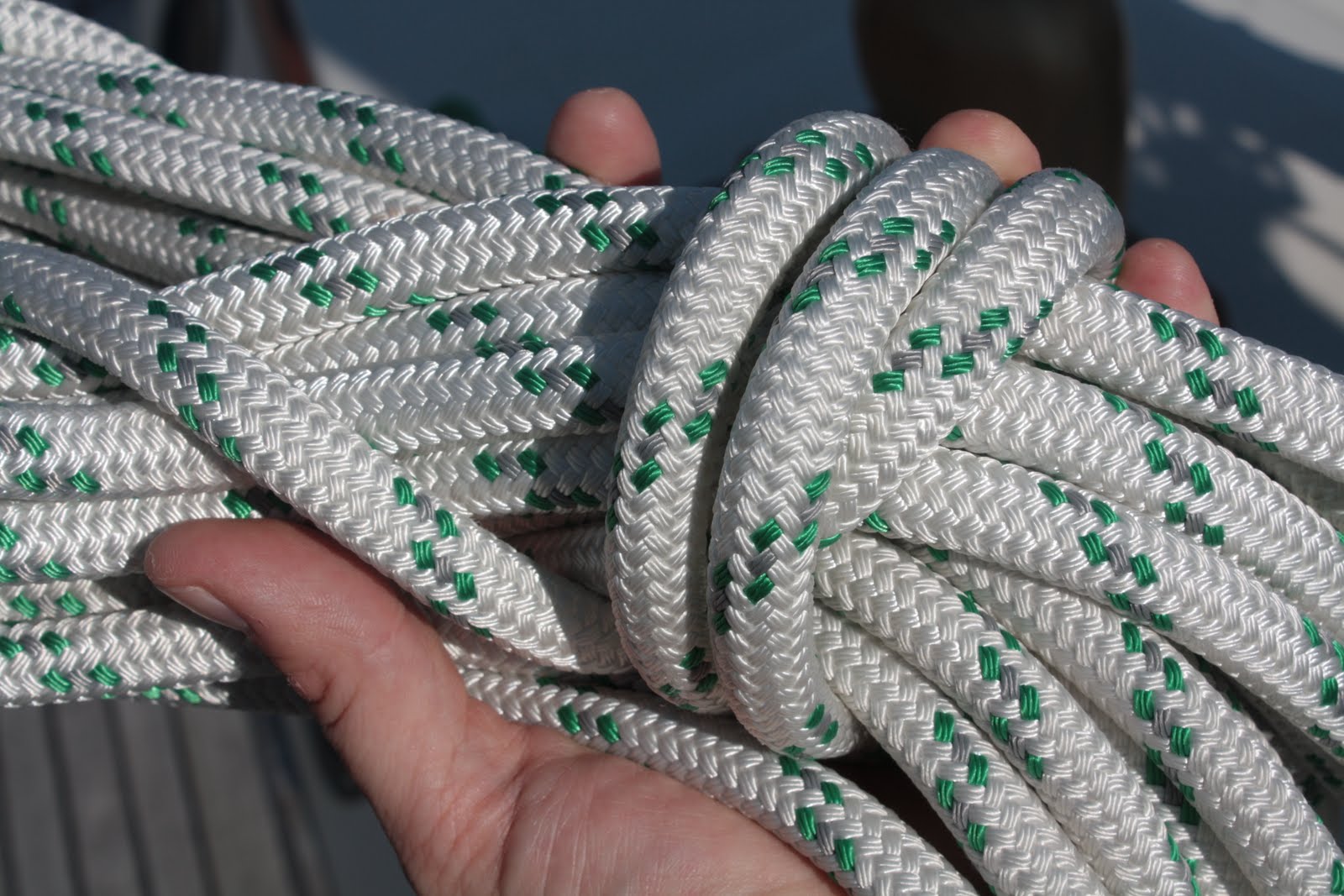
I replaced them all with some really nice XLS Extra.  The stuff has a Dyneema core and polyester cover.  It should last me a decade.  It better.  Even off the clearance rack in the rigging department, the total cost of all the running rigging approached a grand.

I also received my Hook Knife.


It's for clearing lines/rope off the prop shaft or prop.  Yeah...that's exactly what it's for.  It's for safety.  Yeah.

And in the artistic yet functional department...


My old French Country knife, with a square sennet lanyard.

I feel accomplished.

Thursday, March 3, 2011

Stuff: for a boat now

Warning: long somewhat poseur philosophical rambling follows.

As I look at the systems on Brigadoon and my plans on going places in this boat, I have thought a lot about systems that I have, which ones need an upgrade, which ones I need to obtain, and which I need to junk.

I mean, I could load the boat up with the latest in chartplotter/radar/AIS/VHF/depth/fishfinder/watermaker/inverter/tv/vcr/dvd/blueray/blender/microwave/hot tub/etc/etc/etc

I could spend a fortune loading the boat with gadgets. I could also have to quadruple my battery bank to support them. I could get ridiculous with it. Or not...

So I'm looking at what is really necessary, what can be re-purposed, what can be used for dual purposes. In this I'm examining *if* I really need to get an outboard (which requires a place to stow, a lock so it won't get stolen, gasoline, gas/oil mix if it's a two stroke) for the dink. The thing is, as you add one capability, you have to take into account the infrastructure to support it and then, maybe those things need additional infrastructure, etc, etc, etc....

It can be a long and winding road of this thing, supporting that system, requiring an upgrade of another and pretty soon you are so surrounded by what you *have to have* to support something maybe you really didn't need in the first place.

I understand this is blasphemy the manufacturers out there, who want us to consume their "marine grade" pens, pencils, log books, and toasters that they are very very proud of -- just look at the co$t. Well, I don't have to buy all their stuff just because it is shiny and new, because it was reviewed in the latest issue of SAIL, or I think I have to keep up with the Joneses when at anchor.  Frankly I don't care what the Joneses think.  All I care about is whether I have what I need on Brigadoon.

So every purchase is backed up by some questions.

Do I really need this?

Can this capability I'm acquiring be done another way -- especially one that is less costly?

Do I need additional infrastructure to support the shiny new thing and, how much is that going to cost?

What are the unintended con$equences (costs) of the addional infrastructure?

For example, I have looked at a really nice little Honda outboard for my dink. Before I buy that, though, I'm going to get the thing off the davits and row it around for a while before I shell out the money for an outboard. I may find out I don't need it. If I find I do, then at lease I've asked and answered the right questions about it.

Monday, February 7, 2011

On the use of 'crutches' and the objections of 'purists'

We have been investigating the idea of eventually putting a bow thruster on Brigadoon. It will cost about 8-10 grand, the boat has room for the system, it will improve close quarters handling and possibly make the boat safer, especially for single handing.

So, let's address the main argument against such folly.

"Having a bow thruster is a crutch. Learning how to handle the boat you have, without a bow thruster, will make you a better sailor."

While I can get completely behind not relying on crutches to master walking, I see no reason not to use reasonable tools available to me. For instance, I may be an excellent climber/walker, with miles and miles under my feet. That doesn't mean I won't use a belay line, a walking stick, or crampons on ice if I feel they warrant the situation -- and if they improve my safety.

So why am I willing to 'cheat' by installing a bow truster?

I could be able to read wind and current as well as Slocum, sail like Dennis Connor, dock like a Mississippi pilot boatman in heavy current, and master Brigadoon within an ounce of her 22,000 lb full keeled design. All of that may not be enough in some situations and I see no reason not to use a tool to increase my safety and ability to handle my boat. It isn't 'cheating' any more than a Max Prop (which Bob said will improve backing) would be.

Purists *are* right when they argue you should not rely on actual crutches, and instead, should develop a deep and comprehensive set of skills in your chosen pursuit. Purists are also dead wrong when they label reasonable advances in tools, especially those related to safety, as somehow not living up to our potential as experts in our chosen pursuit.

My first few motorcycles had drum brakes? Should I not have graduated to disk brakes when they came out?

Why use chart plotters when charts still exist. Why use a GPS when you can learn to use a sextant and compass? Why rely on weather fax when you can learn to read the skies?

I do have paper chart, compass, and some weather skills kept aside, by the way.

The same purist argument can be made against many improvements in capability and safety. That doesn't mean those argument are always valid.

So, we are considering an eventual bow thruster install on Brigadoon. Until and if then, I'll *also* learn to master all the skills I can to handle her, such as reading wind and current, correct application of the throttle and other skills like using spring lines properly.

Thursday, December 30, 2010

My plumbing is defective

Allow me to explain.

Your water comes from a faucet.  Mine comes from a tank in my boat, which is delivered to our faucet by a small electric driven pump.

That pump was not operating properly and Kerry was unhappy with the performance of my water system.

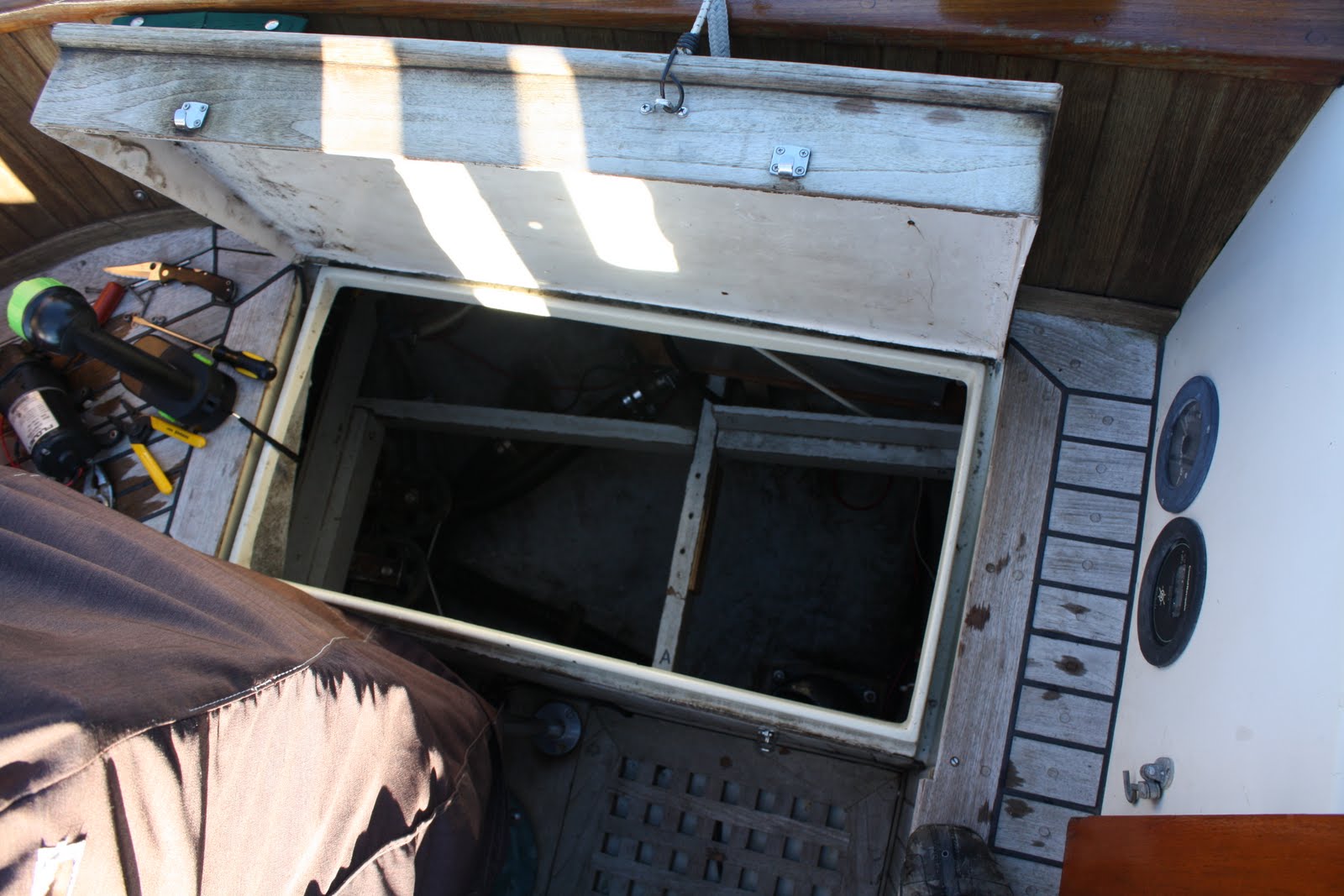
So I promised her I'd do something about my defective water system soon.  Today seemed like the day.  I set out to clear a space under the port side lazarette, where the little water pump lives.  This meant hauling a bunch of stuff out into the cockpit (I didn't mean that pun -- sue me), and climbing down into this space...

This is the area under the lazarette when it is empty of stuff.  This is where I'd have to squeeze my ass, arms, legs, and tools into to get to the little pump and remove it.

Now, today was freezing, literally, but it was nice to climb down into the space.  At least I was warm.

When I got down there I assessed the situation.  This meant looking over the stellar wiring job (this is the first negative thing I have said about the previous owner at this point) that awaited me on this job.

"Wire nuts? Wire nuts on a fucking boat?" I said out loud.


Yeah, wire nuts, and butt slices, all corroded, that pulled out in my hands.  The pump you see here is the bildge pump.  It's what keeps my home from sinking should the basement (bilge) develop a leak.  In sorting out the wires, I pulled the corroded connections for the bilge pump loose from the multiple butt splices (sometimes two or three per wire run) and the male/female spade (no shit) connectors.

So I had to rebuild the wire connections on the bilge pump too.

But the little water pump wasn't that hard to pull out, if you count being crouched in the space, arms bent up, then down, trying to get at the mounting screws.  Finally it was out.

That's it, one defective water pump and one soaked crotch (see photo above). After changing my pants and hanging my soaked ones up to dry, we headed for Fisheries Supply to get a new pump.  After figuring out they had the right one and finding a strainer recommended by the manufacturer, I headed for the electrical aisle.

Yes, I got butt splices.  I also got diaelectric grease for the insides of the splices, to prevent the very corrosion I discovered at the start of the job.

Returning to Brigadoon, armed with new pump, strainer, splices and a sandwich, I got to work.  Kerry was very patient as I, buried in the lazarette up to my shoulders, called multiple times for help; get this tool, hand me that, etc.

It took more time figuring out how to de-splice, de-spade, clean up the wiring than actually doing it.  However, once started, I removed about eight connections (opportunities for failure and corrosion) and replaced them with exactly two.  The new pump was in.  Now to flush the system and proclaim victory.

Not yet...

The damn system finally flushed the air out of the sink in the head but the galley faucet would not flow.  It was very frustrating.  Finally after staring at it for a while, I unscrewed the aerator from the faucet and -- sploosh! -- water everywhere.  The damn aerator was clogged with a teeny piece of debris.  Now the thing worked.  The pump happily chugged along, shutting down when I closed the faucet.  Success!


Except the quick release fittings on the pump leak a little.  I took care of that with a quick trip to the hardware store for various sized "O" rings.  I'll soak my crotch again when I install them tomorrow.


Your water comes from a faucet.  Mine comes from two stainless steel tanks buried under the cabin sole of Brigadoon.

Wait until you hear about where my electricity comes from.

Thursday, November 11, 2010

And now, the list...

Now that we have Brigadoon, I have a list.

* solves survey items -- some of these must be fixed in by Dec 1.

1) Remove the electric head, close the inlet and outlet sea cocks, cap the sea cocks, pull the macerator, pull all hoses, pull the holding tank, wreck the electrical serving the macerator. *
2) Install a Natures Head (Composting Head). *
3) Relocate the Dickenson Diesel stove. *
4) Verify the safety and integrity of the propane stove system. *
5) Relocate the aft nav light (blocked by dingy on davits). *
6) Replace corroded hose clamps.  *
7) Ground fault 115v socket in galley. *
8) Rebed all eight of the chainplate escutcheon plates to stop minor leaks. *
9) Review and clean up *all* electrical connections.
10) Inspect, wash, and condition all the lines on the boat.
11) service the winches.
12) secure batteries better. *
13) get new battery boxes.  *
14) investigate increasing battery capacity.
15) deal with chafe issues on some hoses and electrical lines. *
16) replace some of the lifelines. *
17) bond some unbonded through hull fittings.  *
18) replace welding cable for actual tinned battery cables. *
19) service manual anchor windlass

Long term:

1) cutlass bearing in a year.
2) refrigeration system
3) get sails inspected, cleaned and resewn as necessary
4) maybe get an assy spinnaker for the boat.

So, that's the short list.

There is, of course, a complete inventory of the boat, some rerouting of lines to make single handing easier, a lot of creature comfort stuff.

So much to do.

Monday, November 8, 2010

Camping on the boat...and heads.

There are a few moments when it really hits you; this is mine.

One of those is when you sleep on the boat.  It's reinforced when you sleep on the boat again, and you've addressed issue raised during the first night.  We stayed again on Saturday night too.

We took delivery of Brigadoon on Monday the 1st.  We didn't get to sleep on her until Thursday night.  We stayed there, sorting things out, went out for dinner and shopping in our new neighborhood.  We made plans to address some things short term and get a list for long term.

Our friend Thor, who lives at the Fremont Tugboat Marina, on his Catalina 36, stopped by on Saturday and Sunday to lend us a hand.

One of the things we had to do was make some more room in the salon.  This involved removing the huge teak salon table and putting it in storage.  We are planning on building a smaller, fold-out table in the next few weeks. We also removed the custom boat cover and other unnecessary sundry off the boat while we were at it.

Sunday, after a night learning how to quiet my main halyard from smacking the mast (smack, smack, smack) at 3:00 in the morning, we woke to a beautiful Lake Union outside our ports.

Sunday was the day we would full the water tanks, figure out if the propane systems are working properly, learn to get the boat off the dock and get out in the lake.  I needed to learn how to handle and drive my boat before we took her over to the boat yard for some engine repairs.

 So, we spent the afternoon with Thor on board, driving in circles, backing her up, and generally playing around in the middle of Lake Union.  This boat "backs like a drunken sailor," as my friend Thor put it.  It took come coaxing but I finally learned out to handle her with proper use of throttle in forward and reverse, some cursing and Popeye facial expressions.  

I finally became confident enough with that we....


Actually Went Sailing! Finally! For the first time in our possession Brigadoon had some real wind in her sails.  We sailed her under main and staysail, leaving the genoa out of the mix for now. The boat really pointed well.  As soon as we got the sails powered, she heeled about 20 degrees, stiffened and took off.  I'm going to love sailing this boat.

Kerry did a great job as first mate, making an awesome lookout and doing her hand at the wheel.  Thor and I handled the lines and mostly drove the boat, except when we threw the wheel at Kerry and said, "steer this boat into the wind."  She did great.

The sky to the south was starting to threaten. We didn't want to be docking at the boat yard in a pouring rainstorm so, we stowed the sails and headed west to raise two drawbridges.  I drove the boat more and more, getting the feel of making her spin in place, hold station and drive under the bridges.

Brigadoon, at full throttle (2800 rpm), seems to make about 4.7 kts, though it seemed faster.  I'll have to verify the knot meter with a GPS.  Throttling back to 2400 rpm still showed 4 knots, so that looks like my cruising speed.  My research says we have to calibrate the knot meter.

We made it to the boatyard dock and, after puttering around and deciding how to land her, did so with no drama, no dents, no scuffs and no stress.  It was awesome.  It looked like this when we were done.


Brigadoon will sit there a week while the engine work is completed.  We don't get to sleep on her until Saturday night.  Until then we get to plan to work on planning the following big project:

1) Wreck (decommission) the head and septic system on this boat. It stinks.  I see no reason to throw money at it to deal with sewage on my boat. Besides, we want the storage.

2) Order (done today) a composting head for Brigadoon.  We have two friends that use this system and, aside from being Coast Guard approved it, doesn't stink, it requires almost no maintenance, and is very very green.  It basically turns poop into dirt.  You dump the liquids at the marina head.

We are getting a Nature's Head.

Removing the head system will provide many advantages.  Kerry has been very excited about doing this (she won't shut up about it -- and that's good).  I've been moving along slowly, weighing options, before doing the wrong thing.  Well, it's the right thing so, we are doing it.

I have to wait a week for my boat. That will give us plenty of time to plan before we move aboard the weekend of the 13th.

 Thanks for your help, Thor.  I couldn't have done this as easily without you.