Showing posts with label safety. Show all posts

Monday, December 30, 2019

Leaving Home and Arriving Home

We had spent a month cruising South Puget Sound, getting ready for the departure we've talked about, planned about, worried about, checking our boat and ourselves out for the 830 nm journey from Port Townsend to San Francisco. The month was time well spent discovering and fixing problems with things like solar panels (broken wire fixed at anchor), getting used to the navigation software and to the pace and rhythm of traveling again.

I was focused on the safety and seaworthiness of Brigadoon and the care and feeding of her crew. We'd agreed to take a friend along on the offshore  journey -- Patrick had called us and wanted an adventure. He'd never been offshore on a sailboat before.

Patrick, Donn, and Kerry at Siren's in Port Townsend
Our charting and weather software estimated our voyage to be approximately five days.

We left Port Townsend on Thursday morning, September 5th at 11am.  It took 11.5 days, with stops in Port Angeles, Neah Bay and Crescent City, California.

This was to prove our most challenging journey to date.

The trip to Port Angeles was calm and uneventful.  A nice quiet start.  Kerry waved goodbye to her parents as we passed the Point Wilson lighthouse.  The three of us walked into town and enjoyed a nice Italian dinner that evening and went to bed early to be ready to fuel up and leave for Neah Bay the next morning.

An hour out of Port Angeles, the wind was on our nose, we became enveloped in thick fog and the waters started to churn.  We then slowly inched our way to Neah Bay in increasingly foul conditions.  Kerry had to put on the patch and struggled with seasickness.  It took us 14 hours to get to Neah Bay that day.  We entered the unfamiliar harbor in quieter conditions, but at night.  Kerry used our powerful flashlight beam to find our slip as we slowly motored in.  We stayed for two nights so we could rest up.  I changed the oil, discovered our impeller belt needed to be replaced, and made sure everything was in order.

We departed Neah Bay in pea-soup thick fog and motored out the Strait and into the Pacific. Facing calm conditions, and a fog that slowly burned away under the sun, our course took us farther and farther west until we were 100nm offshore. This was to avoid the rougher waters common along the Washington and Oregon Coast and to give us some experience being really out there.

That was an odd part -- the world -- the land -- just going away.

Kerry and I shared the watch schedule - at night, 3 hours on, 3 hours off.  During the day, we played with 4 on and 2 off.  It seemed to work pretty well.  Patrick helped by keeping us company when he was up and doing the lion's share of the cooking and dishes.  Based on our experience on this trip, I know Kerry and I can do this alone when we do our next longer voyage.

First Sunset at sea - September 8, 2019
 And there was no wind, or not enough wind. All the forecasts we studied showed winds of 15-20kts. This would have been perfect for Brigadoon but the winds weren't 15-20kts.  They were more like 6-8kts.

Combine this with the 2-3 meter swells that made sailing well nigh impossible. There wasn't enough wind to keep the sails full and powered up as the swells caused Brigadoon to roll enough to slat the sails and make them useless.

Then there was me, rigging the Asym sail backwards...you'd think I'd learn...

There's always something to learn, some new challenge to figure out while underway. This trip was going to be about engine and fuel management.

Ironically - Kerry and I both used the patch on this trip and Patrick didn't suffer from any discomfort at sea at all.

We were 100nm north of Crescent City when our calculations made it clear that we wouldn't have enough fuel to make it to San Francisco with an adaquate reserve. So, we decided to divert to Crescent City for fuel.

We stayed in Crescent City for two nights also.  Again - rest was needed at this point.  I changed the oil again, we did laundry, took showers, rested.

The final leg to SF was similar -- strong rollers and little wind. Our 4000hr Yanmar engine pushed us along at 5 kts and a quiet(er) 2100 rpm than our usual 2600 rpm. All I had to do was check and top up the engine oil every 24 hours and ensure the fuel filters were flowing and we were good to go.

We spent the last day along the California coast planning our entrance to the Golden Gate and San Francisco Bay. Various guides warned about traffic and current challenges entering the bay. They all cautioned against rounding Point Bonita and crossing under the gate during an ebb tide -- something about heavy currents and rough water (seen this before many times in the Puget Sound).

So we slowed a little and, instead of sailing under the Golden Gate on a beautiful sunset, we had to wait and enter at about 9:30 PM. The ebb was down to about 1.5 kts and I knew we could handle that. It was a rough and bouncy ride anyway, around that point, but as soon as we turned in towards the bridge the point shielded us from the two meter swells that were banging against that current. After I stood at the wheel for over an hour, riding Brigadoon like she was an angry horse trying to toss me off, we finally approached the bridge.

And there we were, crossing under the Golden Gate.

The bay was calm and beautiful as we motored past the Golden Gate, past Fisherman's Wharf and the city, past Treasure Island and under the Bay Bridge and finally into our slip at 11:30 PM.

That was hard. We were beat.

We covered 822 nautical miles in 11 days, with four days at the dock, and 179 hours of motoring that engine.

Alameda is nice. We have a home for a while.

Brigadoon in her slip in Alameda - September 17, 2019


Friday, July 7, 2017

Decisions, Decisions...

Written by: Kerry

At the dock in Cow Bay Marina, Prince Rupert, BC
I think it first occurred to us that we may not make it all the way to Alaska when we hit Nanaimo and realized that we were already half way through May.  It came up in conversation once in awhile, but I always countered that we still had time and the whole goal of this trip (for me) was to make it to Alaska!  So onward we went, ever northward, with the goal in mind of making it, at the very least, to Ketchikan.  You see, when one cruises to Alaska on one's own boat, you must check into customs in Ketchikan - that is the process and there are no alternatives.

With this in mind, we did not waver on our commitment to take as much time as we needed to journey north, whether from waiting out bad weather, or simply needing a day or two of downtime to rest and enjoy the beauty around us from a safe harbor or anchorage.  We reached Shearwater, another milestone along the way, on June 20th.  Time was ticking away.  We'd agreed to be back in Port Townsend by the first week of August, so that we'd have enough time to see family and friends, attend the Perry Rendezvous (an annual gathering of Robert Perry designed boats) in Port Ludlow, and prep for our big trip south.  The plan was to leave PT by the end of the summer, heading to San Francisco, down the rest of the California Coast, and on to Mexico by winter.  We wanted to reserve at least 2-3 weeks to make the trip home from Alaska, planning to travel quickly via more open water on the west side of Vancouver Island, but also account for weather delays, etc.  On June 20th, with not a lot of time left, we pressed on.

Fast forward to the last couple of days travelling up to Prince Rupert.  I started seriously questioning this need to get to Alaska.  Donn listened. He kept telling me it was my decision - saying he had always signed on to go up to Alaska and we would, because it was my dream.  My original plan was to get up there with enough time to truly explore SE Alaska a bit and see some of its beauty from our own boat.  But with time ticking away, my heart and brain were struggling to come to terms with not making it all the way to Alaska on our trip to ALASKA.

On our 10 hour day motor-sailing to Prince Rupert, we reached a point where our cell phones started receiving service again.  I hadn't talked to my mom in a few weeks, so Donn encouraged me to give her a call.  I did.  We were so happy to hear each other's voices again and, as we quickly caught up, I explained my dilemma to Mom.  She listened.  I kept talking through my thought process and the pros and cons of each path.  If we stayed in Prince Rupert and didn't go on, we could actually spend a couple of weeks relaxing in one place, explore a new town, get some more projects done and prep ourselves for the adventure of getting home.  If we continued on to Ketchikan, we would have fulfilled our goal of getting to Alaska and we'd get to experience Ketchikan.  As I talked, it became really obvious to me that my mind was reaching a decision.  Our conversation ended with my promise to call after arriving in Prince Rupert to fill her in on final plans.

Can you guess what we've decided to do?  Yeah, we're staying put.  The minute I said it out loud, a huge peace fell over me.  That night I slept over 12 hours.  My body needs rest, my soul needs to put down (temporary) roots for a little while.  Donn is pleased also.  We worked with the marina manager to stay here for a few weeks and voila - here we are.  We've already explored town a bit, they have a nice library and pool that I hope to make use of.  We've done some grocery shopping and lots of laundry.  Tonight we may even go see a movie!

Having that goal to reach Alaska got us this far.  I'm really happy about that.  As far as needing to go all the way across the border, well, I'm okay with not making it.  This trip is for us - to learn, to shakedown the boat and ourselves.  We're doing that.  We're seeing amazing places and meeting awesome people.  I really have no complaints, and so much to be thankful for.

So we're in Prince Rupert until July 22nd or so.  Another exciting announcement is that we will have a 3rd crew member joining us for our trip home, to help with our virgin off-shore passage.  David Cohen, a good friend of ours from Seattle, is flying up here on July 19th.  He's part owner of a J-boat, has lots of sailing/racing experience and in Donn's words is "competent, sane, responsible and familiar".  Should be a good trip home.

The "Outer Passage"

Written by: Kerry
TWO roads diverged in a yellow wood,
And sorry I could not travel both
And be one traveler, long I stood
And looked down one as far as I could
To where it bent in the undergrowth;        
Then took the other, as just as fair,
And having perhaps the better claim,
Because it was grassy and wanted wear;
Though as for that the passing there
Had worn them really about the same,        
And both that morning equally lay
In leaves no step had trodden black.
Oh, I kept the first for another day!
Yet knowing how way leads on to way,
I doubted if I should ever come back.       
I shall be telling this with a sigh
Somewhere ages and ages hence:
Two roads diverged in a wood, and I—
I took the one less traveled by,
And that has made all the difference.

- Robert Frost (The Road Not Taken) 1920

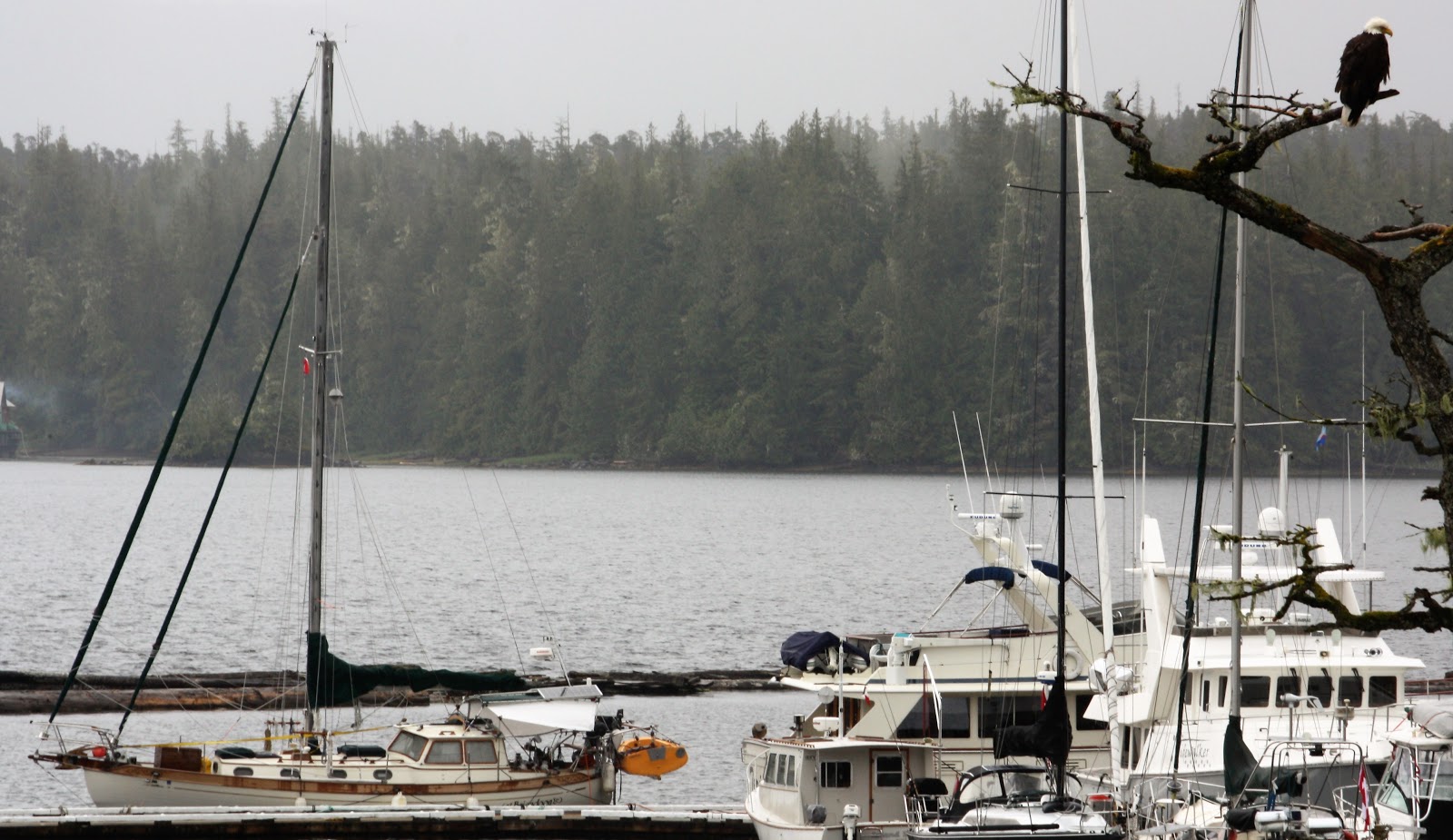
Brigadoon at the dock in Shearwater, BC, with bald eagle.

We left Shearwater on Saturday, June 24th, having done lots of research about our next leg of the trip that would bring us up to Prince Rupert, the typical jumping off point for Alaskan waters.  We had expected to plan and take the more inside route, also known as the "Inside Passage", which follows more protected waters and is used by the BC ferries, many cruise ships, tugs, and most cruisers.  We looked it over closely and weren't majorly impressed with the choice of anchorages - both for distance between them and for depths.  I have no doubt the passages are beautiful and protected, but then we started to look at other options...


From Seaforth Channel into Milbanke Sound, we looked at how to get around Price Island and continue north without going up to Klemtu and the inside waters.  We decided to go to Louisa Cove for our first night out to see what Milbanke was like and make our final decisions on which direction to go, with the primary thought to continue on to Aristazabal Island the following day assuming we weren't too freaked out by the more open water.  Well if you look at the lowest black dot on the map above, that is Louisa Cove - and you'll notice we didn't stop there at all.  Here's what happened...

We were cruising out of Seaforth Channel and I casually brought up the idea of not stopping at Louisa at all, but going straight on to our first anchorage at Aristazabal, Wheeteeam Bay.  Donn pondered that and told me he'd think about it.  It seemed like a beautiful day and the conditions seemed mellow enough to try, so we continued to talk about it and as we broke out into Milbanke, we adjusted the route on the chart and steamed through to Wheeteeam.  The most remarkable moment of that day's journey was going through Catala Passage at the bottom of Price Island.  It's usually more protected waters and gives one a slight shortcut through to Laredo Sound.


  As you can see above, it also requires careful navigation around many islets and rocks.  We were both on point watching our way as we motored through.  It was stunning scenery, almost ghostly with mists and rock formations all around us.  Unfortunately no photos were taken, as we were so focused on staying safe...

Instead of a 4-5 hour day, we had about a 10 hour day when all was said and done, but we had left early and arrived with plenty of daylight remaining, finding a beautiful place to anchor.  We ended up staying there for 2 nights to give ourselves time to recover and also explore the beautiful bay with its endless coves and inlets.  It was truly stunning.

Low tidal flat in Wheeteeam Bay


When we left Wheeteeam Bay we continued our way north with the next target anchorage at the top of Aristazabal Island - Tate Cove in Borrowman Bay.  This stop ended up being one of our most rewarding and fun of the entire trip.  We arrived on a Monday afternoon and stayed until Thursday morning to wait out strong forecast winds.

Monday evening, as another boat pulled in and anchored near us, we realized we were looking at another Baba - little sister to our boat - a Baba 30.  The best part though?  Their boat's name was "Camelot".  Two Babas in the same cove is good enough, but two Babas with names like "Brigadoon" and "Camelot"?  How awesome is that???   Two boats named after mythical places, both told as musicals. I didn't stop giggling about it all week.

Camelot - Doug and John on their way to Haida Gwaii to meet up with their wives
On Tuesday, we went nosing about in the dinghy...  The cove next to us had a huge floating fishing lodge set up on a barge with multiple ties to shore and dock space for a small sport fishing fleet.  As we came close, they (nicely) warned us away from their dock, as they were expecting a helicopter landing any minute.  We dutifully left and did not return to bother them.  However, as we were leaving, another skiff with a driver and a black dog in the bow came up to us and invited us over to stretch out legs later if we wanted.  It was then we realized there was ANOTHER floating structure behind the lodge.  This turned out to be the home of Rick and Jeanne Beaver and their dog, Skipper.

Home of Rick and Jeanne Beaver
They are a retired couple who started creating this little floating homestead about 14 years ago.  They live here year round and use everything around them - most of their docks and structures were all built from found wood drifted up on the beach.  They create art and tend gardens in boxes and a little green house in back.  The little wood hut at the far left is a wood fired hot tub.  They welcomed us with open arms and a bit later Doug and John from "Camelot" showed up in their kayaks and we all hung out for awhile.  Jeanne and I had a great time sharing stories and getting to know each other while the guys all checked out Rick's various projects outside.  When it came time to head back to the boat, Jeanne piped up and said "Hey! Let's all get together tomorrow evening for a potluck!"  We all loved the idea, decided what we would each bring and bid adieu with promises of more fun the next day.

I spent the next day reading and relaxing on the boat.  Donn went for a hike on his own and then later got picked up by Rick in his skiff with the other two guys (and Skipper) and taken on a tour of the nearby islets and beaches (I stayed behind because I was enjoying my book too much).  We all convened around 6pm and had a lovely evening in the Beavers' home.  I convinced Donn to bring his guitar to entertain after dinner and it was a huge hit.  They loved his music and even suggested he check with a local hotel lounge in Prince Rupert about playing there when we arrived.  It was hard to say goodbye - but we decided we could easily stop there again on the way home - so we hope to see them again soon.

One of Jeanne's gardens, with Skipper in the background
Doug, John, Me, Donn, Jeanne, and Rick

We had plotted out our next stops between Aristazabal Island and Prince Rupert and each one went as planned.  We stayed a night in Weinberg Inlet on Campania Island, which was stunning.

Mount Pender on Campania Island
Then we stayed two nights in Patterson Inlet on Pitt Island due to heavy rain.  We woke up the first morning, knowing we had planned to leave around 10 or 11am.  We listened from our bunk as the rain poured down onto the deck and looked at each other and decided we could afford another day in this beautiful place and not brave the rain just yet.

We left Patterson and headed for Newcombe Harbour inside of Petrel channel, out last stop before a long day to Prince Rupert.  We enjoyed a little sailing that day, although the winds were light.  As we rounded into the channel for Newcombe Harbour, the winds picked up, with rain threatening to douse us.  Donn got two photos as we headed in...


Bald Eagle flying off a perch inside Newcombe Harbour
Newcombe Harbour was tricky, as our ideal anchorage depth was located in a trough in the middle of shallow mud flats.  Water covered it all, so except for our charting software, we had no idea of where those shallows started.  I inched our way in and watched the depth sounder.  As I got a little too close for comfort, I started to turn up into the wind to find a good spot and saw depths as low as 13 feet cross beneath us.  We safely anchored in about 34 feet a little ways out as a huge gust of wind blew us sideways hard, setting our anchor perfectly with the rain letting loose on us all at the same time.  As the rain died down that evening, Donn noted that he could hear multiple rivers and waterfalls around us as we sat there in the middle of the little bay.  This is another spot we hope to visit on our way back, hopefully with nicer weather.

Our final leg to Prince Rupert was about 10 hours - we left at 4:30am to catch Petrel Narrows at low water slack and everything was smooth as we glided through.  I sat in the bow to watch for logs in the early morning light and marveled at the beautiful scenery around us.  Simply gorgeous and so humbling.  We both remarked how happy we were to have taken the outer passage.  We barely saw any other boat traffic under way and never shared an anchorage with more than 1-2 boats.  The conditions were benign, we barely had enough wind to sail, and only did so about 1/4 of the way.  As we plan our return, we'll take this option again - no doubt in our minds.

Sunday, June 11, 2017

Living the Yotting LIfe

Written by: Donn

We are six weeks or so into this adventure of cruising on the yacht Brigadoon. It's been five years of planning, five years of sacrifices, hard work, missed schedules, changing plans, but we are here.

"It's been a long road,
getting from there to here.
It's been a long road,
But our time is finally near.

I can see my dream come alive at last..."

Getting this far has been a beautifully challenging mix and, it's nothing, I tell you, nothing like living on land. The interesting thing has been the assumptions we've been witness to and the target of, as we embark on and continue this adventure.

For example, in a conversation about my country (The USA) a friend raised a very political question about our immigration policies:

"There are no developed countries a US citizen can go to and, so long as we physically make it onto the soil, are welcomed with open arms, no questions asked, and immediately provided all the benefits of natives. No matter who we are or how sad our story, if we don’t follow their rules we’re turned around and sent right back where we came from. They require we follow their rules or they don’t let us in.

The same countries we’re jealous of for their “free” healthcare and extensive social programs also have very strict immigration rules. They clearly value the interests of their own citizens over those of others."

My basic response was, "We (edit: this country) are rich enough to take them all and provide for health care for all, if we choose to. There is nothing special about being born here."

I meant it. My country is rich beyond measure and, if it weren't for the greed corrupting our high ideals, I truly believe we could set an example to the world, if only we wanted to.

Setting that political question aside, because I have no interest in debating that here, I'd like to focus on his response and the assumptions contained therein.

"Since I know you to have a very good sense of humor I'll just ask: Are you being funny, or is a guy who's currently sailing around the world on a yacht telling the rest of us how easy it is to embrace the huddled masses?

My friend has since apologized for his assumptions, that we are some rich, well off yachties, sailing around the world, telling him and others what they should do with their guilt. Let's talk about those assumptions, because this isn't the first time we've run into them. They are in Facebook posts about young couples who threw it all way to take on the sailing life, tossing aside the normal cares of the work-a-day world, leaving all of those wage slaves behind. They visit tropical islands, far flung places, arriving on their yacht, only to depart for another paradise the next week.

Allow me to inject a little reality into this life we have chosen and share a little bit about us.

First off -- the money. We are not rich, or even well off anymore. True, we had fairly high paying jobs but, we used all those resources to pay off our debt, outfit our yacht to make her safe and seaworthy, and set aside a little for living expenses. There is some savings but, we are basically unemployed at this time and I, for one, have no plans on ever working for anyone else, ever. Not ever again. I'm working on a novel, which I hope people will like and buy but, aside from that, it's our savings and my modest retirement that will see us through this adventure. Money aside, let's talk about what it's been like to go cruising on a yacht.

Brigadoon is our home. She contains all our earthly possessions within the confines of her hull. This includes clothes, food, art, tools, spares and anything else we think we might need. That means that, when we are sitting in a beautiful cove, surrounded by towering firs and cedars, with eagles flying overhead and otters playing in the cove, we still have to fix that leaking water pump or get that diesel stove working so we can keep warm. There is no ordering of parts from Amazon Prime (and getting what we need in two days). There is no mechanic to call, who will arrive and fix the problem while we go out to dinner and a movie. There is no store to drive to (if we still had a car), to get what we need. We have to be resourceful and make do with our resourcefulness and parts on hand. No one is coming to save us.

Imagine if you had to work on sink at home. The water isn't coming out. You can't just have someone replace it. You can't just run to the big box hardware store in your car and get a new faucet. Water pressure is supplied by a pump, not the city. By the way, all your water (80 gallons of it), is stored under the floor of your living room. The pump is located in the corner of a closet, hidden behind fishing poles, dock lines, buckets, and a host of other things that must be stored there. You have to remove all those things to get to it and, they have to stay on the boat. There is no spare room to move them to, so you stack them in your small back porch, hopefully in a corner so you can still walk around.

You need tools and spares.

The spare water pump is located under your bed. Not under it like you just reach under a regular bed under it, like inside the the box springs, under the mattress. You have to lift the mattress with the block and tackle (it weighs 80 pounds) and dig though various spares.

Tools are located under and inside your couch in the living room, so you have to tear all the cushions off and put them on top of your bed. The rest of the tools and miscellaneous spares are located under the cushions of your love seat, so you have to take the cushions and pillows off that too and put them on your bed.

You now have absolutely no place to sit, but it's time to get to work while otters play along the shoreline and majestic bald eagles hunt from hundreds-year-old fir trees along the granite cliffs surrounding the beautiful cove in which you are anchored.

You work on the problem until it is solved, or you give up for a break -- remember there is now nowhere to sit? You get back to work until you solve the problem. Simple as that. You have nothing but what is on the boat and you can't go get anything else you need. When you do finally solve the problem, because you have to, you simply have to, you put all the stuff back.

All the tools and spares have to be put away in some semblance of order so you can find/use them again. Once that is done, you dig all the cushions our of your bed and put them back on your couch and love seat so you can sit down again.

If you are skilled, resourceful and lucky (never discount this), you fixed the problem and can now enjoy the paradise in which you are currently anchored.

Then the house heater malfunctions the next day. You start moving cushions again, lather, rinse repeat.

Until the next problem.

So you plan your road trip to a destination twenty miles away. You check the weather, because winds and road conditions can literally swallow your car and everything you own. If the road is too bumpy today, it might be too dangerous to go. You double check the route to make sure there are no obstacles in your path on maps you have never seen before, and you have to trust that they are correct. If they aren't, and you hit one of those obstacles, the road can literally swallow your car and everyone inside. You might want to call for help or a tow but, no one may respond and, if you really screw up, no one is likely to find you. You make sure you have enough fuel (there are no gas stations en-route). You make sure you have enough food in your fridge (there are no stores on your route). Do you carry spares or a means to replace or repair every single part of your vehicle (there are no stores or mechanics along your route). Do you even know how?

Then, if everything is ready, you leave the beautiful cove, with the playful otters, the shell beaches, the hunting eagles and the bears (don't forget the bear spray). You take the car our of park (manually lift a 46 lb anchor and 160 lbs of chain) and hit the road.

Along the way you may find that the weather report lied or the conditions simply changed. The roads are now outright dangerous. You have to find a safe parking lot and you hope your parking brake (anchor) can hold you in place until the weather passes. You find it and decide dinner is called for -- the stove doesn't light because one of the propane tanks is empty, so you have to go out to the back porch and switch to the backup.

Then you discover the knocking noise every time you turn the steering wheel...the last person (not you, then you who tried to fix it the first time) didn't solve it.

But the place you parked is beautiful and, when the storm blows over the next day, you find yourself in a Yottie's paradise, surrounded by towering fir trees, hunting eagles and kingfishers, otters and maybe an occasional porpoise or whale. You are in paradise for a day and, to be honest, it was worth it to get here, even if the bumpy road tossed everything in the car just simply everywhere.

But you earned every eagle, every otter, every skinny dip in a warm mountain lake, every stroll along pristine shell beaches.

Even if no one really understands what it took to get here.

And you'll do it again the next day, and the day after that, because you want to.


Tuesday, April 11, 2017

We Have a Mast

It's been a long road, with tons of sanding disks, rivets, taps, machine screws, tape, Lanacote and some blood here and there. After all that, today, the stick went in. We have a mast.

Photos courtesy of :Ray Zebas

Thanks to Anders and Jeff of PT Shipwright's Co-Op and Gus the crane guy.

Oh, and Kerry, my dedicated and hard working First Mate.

The day started out calm and promising.

Brigadoon lay ready for her mast.

Gus the crane operator arrives as promised, making us very happy, after we have to cancel yesterday. He did some quick schedule juggling yesterday and wrote a check of hope he cashed today. It was great to see him arrive early.

And here comes the mast, for the second time in as many days.

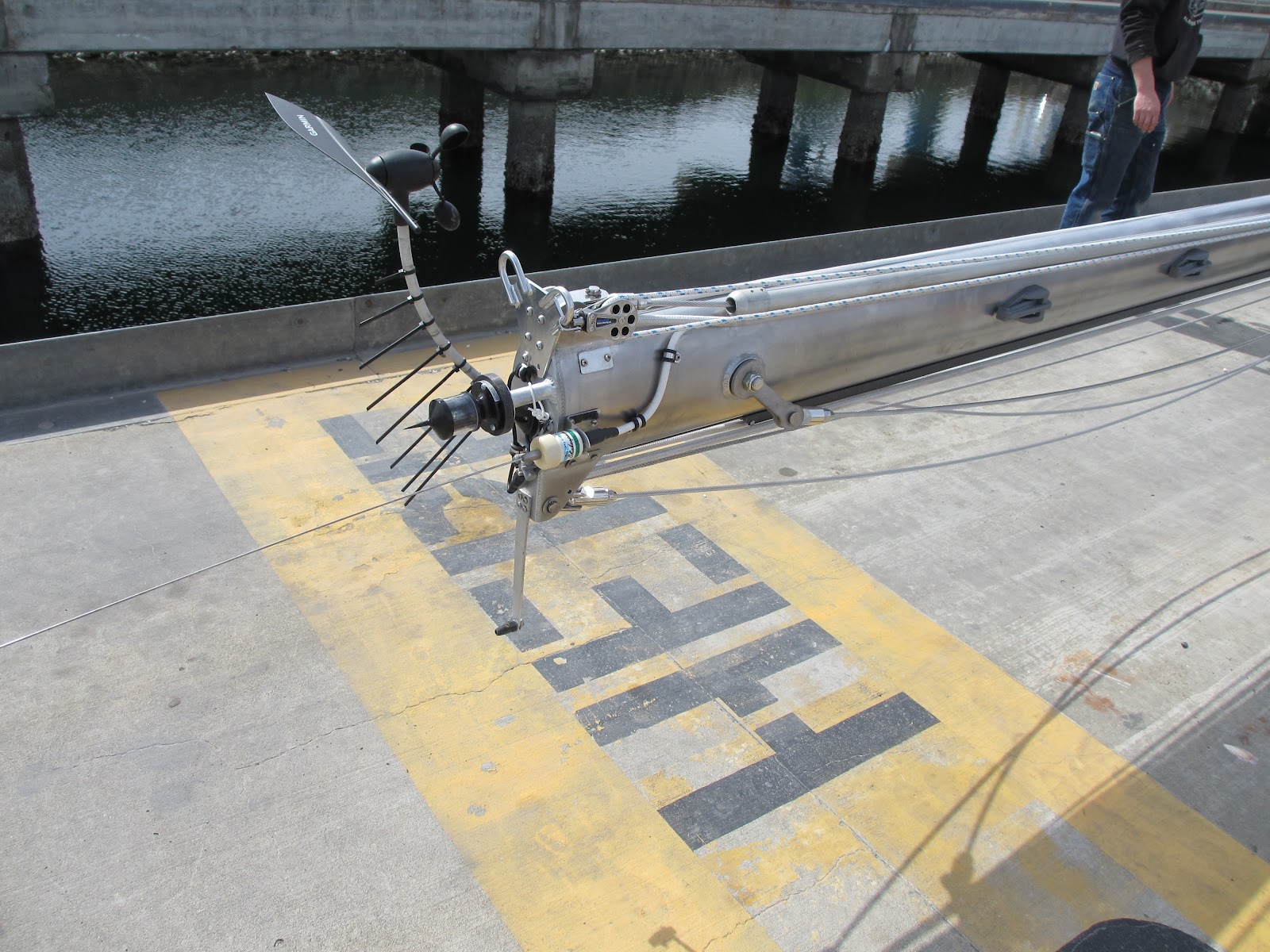
Masthead, with anti-bird Mohawk.


All wrapped up nice and safe.


Gus, the crane operator, rigging our mast while some guy who I have no idea who he is, tries to stuff a check at Gus. I was too busy to whip out my, "do you mind waiting just a moment and not distract my crane operator while he is rigging my job," speech. I still puzzle at it, looking at this photo.


Check guy goes away, the spar is rigged and up she goes.


Some very careful walking to Anders and Jeff...

Kerry hands it back to Jeff, who came down to the boat...

And we get ready to lower the spar.

Kerry clears the electrical, which has to feed down first.


Anders and Jeff, making sure it's right.


At this point the spar is mostly in the boat.

The unskilled help is sent below to catch the mast.

After some wiggling, the spar slipped onto the step.

Furlers are installed.


The smooth as glass marina made this job much easier. It would have been very difficult yesterday.


And there she is, with her spar standing and rigging good and snug.

Friday, December 23, 2016

Weapons as Security

Written by: Donn

I have written about security and firearms before.

There are no firearms aboard Brigadoon, nor are there any plans for them in the future.

“Well,” the internet forum user responds, “I’d rather be judged by 12 than carried by six.”

Good justification. I like the succinct quality. The brevity, almost lacking in foundation of thought…but I digress into criticism where the reasonable thing to do would be to offer my well-thought-out reasoning to support my position.

First, a little credentialism or, as reasonable people like to say, “establishing the context and the experience of the speaker.” Note that this is not speaking from authority. It’s the experiences I’ve gained that formed my decision, not the titles I held or the places I served.

I’m as experienced and comfortable with firearms as I need to be. I learned to hunt at thirteen years of age, maintained expert weapons qualifications scores in the military, scored at the top of my class in the police academy, shot expert in Army qualifications before being deployed to Iraq as a private security contractor, along with training private security in general and advanced defensive tactics.
So, former military, LEO, mercenary and instructor. This informs but part of my decision, along with the opinions and experience of my First Mate and partner, Kerry. She is also experienced and comfortable with firearms, having worked in armed security in the past. This is from where our opinions are formed.

So, while there have been in the past, there are no firearms aboard Brigadoon, nor are there any plans for them in the future.

Why?

We have come to the decision that the complications far outweigh the potential benefits.

If I chose to carry I’d have to:

·   Declare the firearms in every port, to every customs official. I’m smart but, foreign jails are full of people who thought they were smarter than local customs folks when they thought their hidden weapons/drugs wouldn’t be found.
·       Change my cruising plans, and miss perfectly safe destinations due to their laws.
·       Deal with each individual country’s views and laws for firearms, some of which may put me and my crew at legal risk. “Billy? Have you ever been in a Turkish prison?”
·       Ensure that the firearm is properly maintained in a salt water environment.
·       Ensure that the ammunition is properly stored for a salt water environment.
·       Ensure that the firearm is properly stored to protect it from theft.
·       Ensure that every single person on board who has access to the firearm is fully trained and competent in its use.
·       Understand and accept that the mere presence of the firearm means that it is there to be used, misused, lost, or stolen. Three of those four are unacceptable.
·       Understand and accept that it may become common knowledge that we have firearms aboard.  People do talk at ports ya know, especially if you check in with a nice semi-automatic or two, and have the port officials hold your weapon.
·       Understand and accept that our firearm may not necessarily protect us from people that want those firearms, our other possessions or us.
·       Understand and accept that, by the time one of us is pulling the trigger, and possibly taking the life of another, we better have taken countless steps in order not to get here – that is; shooting someone.


There are many steps we can take to mitigate risk to ourselves and our vessel.

A firearm does not need to be one of them.

More Reading if you are intersted:

http://yes-anything-you-want.blogspot.com/2012/05/if-only-someone-else-had-gun.html


Wednesday, August 24, 2016

Simple Lessons I've Learned

By Kerry Christianson


So last week we got away from our home dock and went wandering a bit.  We stayed on a friend's mooring buoy one night, but otherwise chose to stay in marinas, including Bell Harbor, Port Ludlow, and Blake Island.  We had great experiences in all three, but as I watched other boaters coming and going around us, I realized I have learned lessons that seem obvious to me now, but somehow aren't always practiced by others.

When I was on my trip a couple of years ago with Linda Lewis from Blind Channel to Anacortes on her 45 foot trawler, she taught me many things about safe practices arriving at and leaving from a dock.  One thing she taught is that the person handling the lines should never have to "jump" off the boat.  The person at the helm should be able to get the boat close enough for the line handler to step off the boat safely.  Then, once I'm off, I can starting tying up the boat based on wind, current, etc., as the Skipper and I have discussed beforehand.  It can be fun to experiment with tying down lines in such a way that allows the skipper to use the line(s) to snug the boat into the slip.  Then once you're secured well enough, you both can adjust and add lines as needed to get fully settled in.

Last Sunday, as I made my way back from the shower in Port Ludlow, I noticed a large powerboat had its engine on and the Skipper was taking his place at the helm.  As I passed their finger pier, I noticed the bow line was off and thrown up onto the boat, and two women were still on the dock.  One was starting to climb aboard, and the other was finishing up by removing the remaining two dock lines from the cleats.  Meanwhile the Skipper shouts that everyone should be aboard, once, twice, and three times before she was able to actually get on board.  The wind was blowing the boat (gently) off the dock and she just about tripped on a cleat as she headed for the boat ladder to climb aboard.  Internally I just shook my head.  This is such an easy thing to avoid.

When preparing to leave the dock, remove all additional dock lines that aren't needed to hold the boat steady for the last few minutes while you prepare to depart.  Then the two (or three) lines that are still attached (usually bow and stern) should be run from the boat, down to the dock cleat or bull rail and *back* to the boat.  This allows for all crew to be on board the boat before leaving.  Now the Skipper and crew will determine which line to release first, based on current and wind conditions.  Once that line has been pulled back into the boat, proceed to the final line to bring it aboard also.  No one needs to be standing on the dock to release the lines!  Easy, huh?  After that I stand at the ready with a boat hook, just in case.  Once we're safely out of the dock area, I start putting away fenders and lines.  I wish more people would think through these things - it makes it all safer and easier for everyone.  Thank you Linda, for being my teacher - hopefully I'll be able to pass along a few pearls of your wisdom.

Monday, March 2, 2015

No One is Coming to Save You


I found this graffiti on Capitol Hill, here in Seattle. I was walking among the raucous and busy streets late at night when I spied this.

I stood there thinking, "This is, indeed, a truth."

There is a recent story of a father and son who arrived in Rhode Island late last year. They paid $10,000.00 for a 20 year old racing boat off eBay. They purchased this boat sight unseen. Their plans were to sail it back to Australia. When they told the seller their plans to leave and enter the North Atlantic in February, they were strongly cautioned not to leave in winter conditions.

"When he told me what he wanted to do, it didn't seem like a good idea to start with," the previous owner, said. "There's a reason there's no boats on the ocean in February. That's because it's not a safe place to be."

They didn't listen.

Now, after rescue, the sailors, both father and son, are spending a lot of time defending their choices and deflecting criticism. They have dismissed seasoned sailor's opinions that their rescue should have been unnecessary because their departure shouldn't have occurred in the first place.

They had planned to leave earlier, but repairs kept piling up, which pushed their schedule. They knew they were getting into times of bad weather but they let the schedule, along with their desire to get the boat home, influence their "go" decision.

So the USCG, in true competence and every-day heroics, rescued them off shore, in the middle of a snow storm.

Someone came to save them. We saved them.

Now, before we go any further, I'll state flat out that I am not discussing rescues, who pays for them and, if we all pay for them (mostly we do), who stops these people from 'wasting' resources with poor decisions. It's a waste of time to argue this. Nothing but circles and circles of rationalizations, victim blaming, Randian rationalizations about the convenience of 'personal responsibility' until the responsible person needs help, etc. Add the cries of glee by some that call this a Darwin award (like no stupid decisions were ever made by the speaker in their lifetime) and you have an almost perfect trifecta. One of narrow mindedness, armchair quarterbacking and an almost sociopathy in the disdain for the plights of others. Not going there, in this article at least.

I'm writing to talk about self-sufficiency and independence and the impacts on our decisions that inter-dependence engenders.

As the story above demonstrates, many are willing to 'take their chances' out there, on the understanding that, if something goes wrong, they can make a call, push a button, and someone will come and save them.

In many cases, boats that were abandoned have washed up on shore, or found floating intact and seaworthy. It's fear that drives people off boats in situations they don't understand and try to tackle in ignorance and unpreparedness. This is a common story, one that illustrates how unprepared many people are for the sea.

What if no one was coming to save you? What would you do then?

Perish at sea?

or...

Rescue yourself.

You rescue yourself every time you upgrade a critical system on your boat. You rescue yourself every time you learn more about weather, navigation and weather routing. You rescue yourself by carefully planning your routes without the driving date of a (sometimes arbitrary) schedule. In a hundred decisions before you leave, and hundreds after, you rescue yourself from ignorance, arrogance, hubris and laziness.

“The whole problem with the world is that fools and fanatics are always so certain of themselves, but wiser people so full of doubts.”

—Bertrand Russell (British mathematician and philosopher, 1872-1970)

When you read the stories of rescues, one common theme seems to rise up above all the other noise. The sailors being rescued were very confident, very sure of themselves, cannot be dissuaded by more experienced sailors; they aren't interested in information that flies in the face of what they want to do. These people are the same type who enter the wilderness without training, equipment and experience, ending up with a rescue by SAR volunteers. The arrogance of ignorance is poison to taking on endevours such as sailing.

"Aviation in itself is not inherently dangerous. But to an even greater degree than the sea, it is terribly unforgiving of any carelessness, incapacity or neglect."

— Captain A. G. Lamplugh, British Aviation Insurance Group, London. c. early 1930's.

The problem with this, as documented as the Dunning-Kruger effect, is that the incompetent don't know they are incompetent. They are often the ones so sure, so without doubt, as they stumble along to their eventual failure and doom. The sad part of, because of that self-blindness, that lack of doubt, they can never really get any better.

A good sailor (or aviator for that matter -- of which I am both), doubts. I'm not talking about the paralytic doubt that freezes one into inaction. I mean the kind of doubts that fuel us to redouble our efforts to sail a safe and seaworthy boat. We doubt our knowledge is good enough, so we study. Our skill set may not be there yet, so we work on our engines, our systems, our rigging and ourselves.

We see the trap of expecting someone else to help us in our darkest hour, so we do every single thing we can do to plot a course where that darkest hour doesn't come to pass. We rescue ourselves in every decision we make because, deep down, in our bones, we know, we really know...

"No one is coming to save you."

We have to save ourselves.


Friday, February 13, 2015

Living on the Cheap. Dying on the Cheap.

Boating, actually sailing, for that matter, is not a cheap sport. The inherent problem with owning a boat is the fact that, unlike cars, they aren't as mass produced. Sometimes, no one has the off-the-shelf part you need, so, you have to have it made. That's even more expensive.

What we have to understand about the prices we pay is that not all of them are unfair, or necessarily a ripoff. When a company does the R&D for an item and only sells 10,000 units, they will recover that cost in the price per unit. Actually, they must recover that cost or they cannot stay in business.  If the same unit was going into 5 million cars, they can spread the R&D out a bit and the cost comes down.

Does this mean that some marine supply stores don't sell the *exact* same thing you can pick up at the local hardware store for what seems like half the price? Of course some of them do. They play on the "everything on a boat is expensive" game and, some people pay it.

But what if you don't want to pay it?


See that? This is a perfect example of going on the cheap. It's a photo of wire nuts and short pieces of odd spliced wire on my bilge pump. They don't belong there. The wires were also non-marine (not tinned) and were corroded where the wire was nicked. The pump failed. For lack of a handful of waterproof crimp connectors, a crimping tool, and a couple feet of tinned wire, I had no bilge pump. The house water pump was wired the same way too. Someone before me tried to save about $50.00 on a cheaper bilge pump for their $100,000+ boat. If that pump failed to run and Brigadoon had water intrusion while we were away for the weekend -- sunk boat.

The solution is not to "go on the cheap". Going on the cheap bends your sense of reason. It drives you to get the best deal, which is only measured by getting the cheapest price. It frequently means the person going on the cheap has a big pile of rationalizations why their cheap unit is as good as your more expensive unit. Most of the time they are wrong, as they try to defend their decisions.

Price isn't the only factor here, people. Sure, in America, where we value price above everything else. We don't care where our iPads or iPhones are made, or under what conditions, as long as we get it at a good price.

What matters is value for the dollar. How many times have any of us bought the cheaper of two items, only to have it fail or break on us. We get upset. "Damn cheap Chinese crap!"

But, who bought that, "Damn cheap Chinese crap?"

It's taken me a while to get over my early training. You see, my father served in the military in this country for 23 years. We had a family of six. My father worked second jobs. My mother worked. We were military poor. I was raised in an environment of scarcity, of worry over money, for fear of survival.

Fortunately, today, things are different for us. We have valuable skills that we can sell in corporate environs. We are beyond simply surviving and, for that, we're thankful. In our efforts to pay down debt and becoming truly "free", free from the yoke that debt puts on our shoulders and gives our creditors power over us. So, we shovel money towards debt (might be zero in mid to late summer).

I don't live in a environment of scarcity anymore but, that doesn't mean I'm foolish with my money.

So, what does this have to do with "going on the cheap"?

Everything.

My background of scarcity might drive me to go on the cheap. However, I've learned, over the years that quality matters. If I'm trusting my life, I said, "trusting my life", to the safety and seaworthiness of my vessel and her systems, my primary motivation is not to save a dollar today only to die one dollar richer because a cheap unit failed.

There is always something cheaper that you think can do the job my thing does. I will not argue that. I will argue that, if price is your only consideration, you will get shortchanged eventually, perhaps at great cost, maybe a life.

Balance quality in what you do. You invest in quality and buy the best you can afford.

Save money in creative ways. Anchor out. Cook on board. Learn to splice your own lines. Don't buy useless doo-dads to hang fenders with. Learn to tie a round turn and two half hitches -- you already own the line on the fender. Learn how to use it. Save money in practical ways. That way, it's there when you need to buy the best diesel filtration, bilge pumps, safety harnesses, sails, and engine parts you can afford.

How has this worked out for us?

Our battery replacement project coast 5K. It ended up with the right parts, the right install, and a reliable and flexible system.

Our Portland Pudgy Dinghy and Active Rescue System was almost 5K with the electrical system and sail rig. The lifeboat canopy for this lifeboat (more than just a dink) will cost another $2,500. However, a life raft can cost about $5,000 plus an additional $1,000 a year to certify for a one time use item.

Our planned wind vane self-steering system will cost about $5,000, plus install. Aside from steering our boat so we don't have to, it provides a completely redundant rudder for Brigadoon. If our rudder fails, we can still steer. That's value added to the primary purpose of the unit.

Our sails cost about 14K. Yes, I could have paid less. I could have gone to any number of companies that took measurements (some have you measure) for sails made in Southeast Asia. We could have gotten those sails for about 40% off. Yet, our sails are clearly of a better quality. They are made locally, here in Pt. Townsend. Sail material arrives at one end, and finished, hand-made sails of the highest quality come out the other. Our vendor is here. That is valuable to us.

All these decisions were weighed on value. It was value that drove us to these purchases. It was value that drove us to save the cash for these purchases so we aren't in debt. Our money is our life energy. We sell our souls, our time, to corporations so we can have nice things. We won't waste money but we won't be afraid of quality either.

There are many ways to save money, yet still have quality. Yes, the stainless hardware (if it's the right quality) is just fine for marine use. Alkyd Enamel paint from any quality paint vendor will work just fine in marine applications and will be about half the cost of 'marine' paint. Heat shrink from my hardware store is cheaper -- it's still the same stuff. So, there is nothing wrong with finding value at a cheaper price.

Just don't buy crap that fails that you have to replace. Don't be cheap on stuff that can affect the safety of your boat or yourself.

I see it time and time again, in person and on the net. People put non-marine propane installations in boats. Use the cheapest lines they can for mooring lines. Buy the cheapest chain for anchoring. Thin wall stainless tubing is cheaper than thicker wall stuff. It's also weaker. Cheap anchors bend and break. Cheap light fixtures burn up. Cheap electronics fail. If all you look at is price, you will get burned, sooner or later.

Don't be so focused on living on the cheap that you end up dying because of it too.


Tuesday, February 3, 2015

The 2015 Boat Show...decisions, decisions...

Each year, we make plans on attending the boat show. It's a chance to spend a week totally focused on the boat, our plans, and the execution of same. We can talk about stuff all we want but, if we don't execute on that talk, this will never happen.

This year we were focused on getting information about a few major and projects:

  • Water Maker
  • Self Steering
  • Power generation (alternator/generators, solar, wind, hydro)
  • Batteries
The show also provides us opportunities to consider ideas that pop up during the show. Some of these were:
  • Honda gas powered generator
  • Honda gas powered outboard for Fiona, our Portland Pudgy
  • Propane powered outboard
  • Electric drive for Brigadoon (flirted with this for a day or so)
So, here are some of the things we are considering.

Water Makers

There are many models out there. They range in capacity, power, ease of use, simplicity vs. complexity, cost, and support. We've heard horror stories involving failed units, lousy customer support and difficulty in maintenance. We decided that we would focus on the systems we could see at the show.

Watermakers range in price from about $4K on up to $11K for one that will fit out needs on Brigadoon. That's a large range. Some of the units are very simple and others have a lot of touch screen electronics. We are wary of this level of features and complexity as we just can't run down to the corner store to get a replacement if it fails.

RO Watermaker

The RO unit is one we have noticed before. It's AC driven. This means we have to power it from our batteries, through an inverter. This is not easy to do and, since pulling AC from a  DC batter pack can lose 15-20% power, it's not a good choice. Well, they have an answer. They power it with a Honda 2000i generator. 

Well, that got us doing down the road that suggested gasoline on the boat. If we go with this, we have to have gasoline for the generator. And the generator can be used to put electrons back into our batteries. That also means that, since we have gas on the boat, we can get a Honda 2hp outboard too. They are great engines. So, by purchasing a watermaker to the tune of about $4-5K, I would also have to purchase a generator for $1K, and end up with an outboard that coasts about $1K. 

It's a good watermaker, but I'm not sure of the path it leads us towards; explosive gasoline on the boat.

ECHO Tec Water Maker, sold by Hydrovane.
 The ECHO Tec is sold by the same company that sells the windvane steering we will purchase next year. The unit is either powered by the DC motor you see here, or an engine mounted pump to the right. Either way, the system is price competitive, simple, and serviceable.

http://www.hydrovane.com/other-products/echo-tec-watermaker/

We don't think we want to load up our diesel auxillary engine with the pump. At only 27 hoursepower, our engine needs all the power it can get and, I don't know if I want to side load the crankshaft to drive the high pressure water pump. This is also true for large alternators.

Then...

Back side of diesel genset, water maker pump, and large DC generator.


Diesel Genset with water maker pump, large DC generator, and refrigeration pump.
We saw this unit a couple years ago and deemed it too expensive. However...

This is a Kubota diesel genset. It's is reliable, is built to carry large loads of the high pressure water pump for the water maker and a large DC generator for topping up our batteries. It's starting to make sense. The cost of this unit is comparable to another water maker, plus generator, upgrading the engine to take the generator loads to fill the batteries to run the DC watermaker motor...it's a rabbit hole.

But this. This is a generator. It's a simple machine. It's not that large. It should fit in the stern compartment, behind the engine. All in all, we are seriously considering this unit.

Why? No need to purchase a Honda generator. No gasoline on the boat. It runs on fuel we already have. We don't need to upgrade our drive motor with a big alternator or pump. That way, the only time we are running the engine on Brigadoon is to -- and this is key -- move the boat.

Self Steering

Hydrovane Self Steering unit


Beautiful workmanship here in the guts of the Hydrovane.
Self steering is crucial to crossing oceans. There is not way a person on watch can steer a boat the whole time. You need the machine to do that for you. Because Brigadoon is a pilot house sailboat, with two separate steering stations, we need a unit that is independent from out steering. A regular system that attaches to the wheel in the cockpit is likely to have issues with friction in our steering system.

http://www.hydrovane.com/

Besides, what do you do in a boat with a rudder failure? If you have this, you don't worry about it. The Hydrovane has a separate rudder that hangs off the back of the boat. If our main rudder fails, we can use this one. The black handle you see in the second picture is the emergency tiller. 

We have little doubt we will put this system on the boat in 2016.

Lighting

Replacement Spreader Lights
Our spreader lights are really crappy old Perko units. They are dim, corroded and incandescent. We want all LCD lighting on Brigadoon so, I looked at the new LED lights flooding the market. Many of them use only a few watts but put out impressive amounts of light. Well, we found a model we like at a good price. Stay tuned for the pictures of me climbing the mast and installing these. 

Batteries 

We need electrons on Brigadoon. They need to be held in large batteries. When it comes to power, where you might pay cents for your kilowatt hours, on boats they are more on the order of dollars or tens of dollars. Generating power and storing it takes money. You need a place to store it and a way to make it. 

We took a great class on boat systems from Nigel Calder on Saturday. The three hour talk was well worth our time. We learned about the requirements and complexities of generating and storing power on board. After attending that seminar, we don't think bolting large loads on our ICE (Internal Combustion Engine) just to make water; that doesn't make that much sense. 

Battery technology is really gaining ground. There are flooded batteries (cheap and powerful but not a long life along with requiring regular maintenance). There are AGM (sealed batteries, sometimes called gel cells, that are more expensive and require almost no maintenance. Then there are Lithium Ion batteries. We agree with Nigel that these are not suited for boats. They are too prone to suffer from thermal runaway for our taste. I don't want an unbalanced battery to set itself on fire and burn a hole in our boat while setting the whole thing on fire.

AGM technology is getting there in capacity and cost over flooded. We have about 500 ah (amp hours) in flooded cells right now. There is newer technology on the way for AGMs that looks promising. They can accept a very high charge rate and perform well over many discharge/charge cycles.

We will likely replace our flooded cells with newer AGMs in 2016.

Wind Generators


We know that wind turbines get a bad rap due to the noise some models make. And yes, the winds (10-15 knots) make for good wind but not a good anchorage. Where there is good anchorage, there is little wind. So, why get one? 

The wind, my friend, it is free. It's not a major component of our power generation but it may supplement. I like power from multiple sources so...

Hydro Generators


These are really coming to the fore. Since water is denser than air, the generator is smaller and can generate more power. The nice thing about this model is it's being sold by the Hydrovane guys. They even make a bracket that attaches the generator to the post for the self steering unit. 

Now, this unit is not cheap. It costs thousands but, it's extremely reliable and it generates a lot of power. The fact that it's used on the Vendee Globe and other ocean races speaks to the capabilities of the unit.

We are watching this one too.

Solar Generation

We will get solar. We just haven't decided on which unit yet. Since electronics, especially solar, is making such huge gains over the last couple years, we feel good about holding off on this one until 2016.

Electric Drive for Brigadoon (no -go)

Yes, we actually thought about this. There are some boats out there that have electric drive setups. It makes sense for sailboats because, most of the time, the engine is used to get in and out of a harbor, or through a canal, or a set of locks. That usually doesn't take much power. An electric drive might work. 

All you have to do is tear out the diesel engine (no more oil changes, no more diesel fuel, no more maintenance), build a huge batter bank, and find a way to charge it. Unfortunately the technology isn't quite there yet. Power generation and battery storage needs to catch up the new motors before I'm willing to cross the globe with such a setup. It was a good exercise but, it really came down to putting a large generator on board - much larger than the Kubota above. 

Why tear out one diesel engine to simply replace it with a generator of the same size?

VHF Radio


Our current VHF is a decent radio. It has never failed to perform. However, we don't have AIS capability or DSC ship to ship capability. This radio has that. This means that, even though we will add an AIS transponder to the boat, this will give us an additional AIS receiver, along with a RAM (Remote Access Mic) for the cockpit. We picked this up at the show and will install it this week. The other radio? It gets boxed as a spare.

SSB (Single Sideband) Radio

This a mainstay of cruisers around the world. VHF only reaches so far and, it can't pass data. SSB is long range and can pass data (with the right modem), which means you can get weather charts and email. The system were more complex and expensive but, we think we found a simpler install method that is less expensive, while still using a high quality radio. This is another 2016 item.

In Summary

It was a good show. We made some good decisions around systems, gained some good knowledge from Nigel Calder, got new spreader lights, a new VHF radio, and some galley sundries.

It's a real challenge, figuring out what to do. There are plenty of people out there who are more than willing to sell you something you don't need for a price you can barely afford, to laugh it off as, "well, you need this or you can't go cruising and it's always expensive."

Sorry, not playing that game.

We are going for value, usefulness, simplicity, ease of maintenance and I think we are on the right track.