Showing posts with label seamanship. Show all posts

Monday, December 30, 2019

Leaving Home and Arriving Home

We had spent a month cruising South Puget Sound, getting ready for the departure we've talked about, planned about, worried about, checking our boat and ourselves out for the 830 nm journey from Port Townsend to San Francisco. The month was time well spent discovering and fixing problems with things like solar panels (broken wire fixed at anchor), getting used to the navigation software and to the pace and rhythm of traveling again.

I was focused on the safety and seaworthiness of Brigadoon and the care and feeding of her crew. We'd agreed to take a friend along on the offshore  journey -- Patrick had called us and wanted an adventure. He'd never been offshore on a sailboat before.

Patrick, Donn, and Kerry at Siren's in Port Townsend
Our charting and weather software estimated our voyage to be approximately five days.

We left Port Townsend on Thursday morning, September 5th at 11am.  It took 11.5 days, with stops in Port Angeles, Neah Bay and Crescent City, California.

This was to prove our most challenging journey to date.

The trip to Port Angeles was calm and uneventful.  A nice quiet start.  Kerry waved goodbye to her parents as we passed the Point Wilson lighthouse.  The three of us walked into town and enjoyed a nice Italian dinner that evening and went to bed early to be ready to fuel up and leave for Neah Bay the next morning.

An hour out of Port Angeles, the wind was on our nose, we became enveloped in thick fog and the waters started to churn.  We then slowly inched our way to Neah Bay in increasingly foul conditions.  Kerry had to put on the patch and struggled with seasickness.  It took us 14 hours to get to Neah Bay that day.  We entered the unfamiliar harbor in quieter conditions, but at night.  Kerry used our powerful flashlight beam to find our slip as we slowly motored in.  We stayed for two nights so we could rest up.  I changed the oil, discovered our impeller belt needed to be replaced, and made sure everything was in order.

We departed Neah Bay in pea-soup thick fog and motored out the Strait and into the Pacific. Facing calm conditions, and a fog that slowly burned away under the sun, our course took us farther and farther west until we were 100nm offshore. This was to avoid the rougher waters common along the Washington and Oregon Coast and to give us some experience being really out there.

That was an odd part -- the world -- the land -- just going away.

Kerry and I shared the watch schedule - at night, 3 hours on, 3 hours off.  During the day, we played with 4 on and 2 off.  It seemed to work pretty well.  Patrick helped by keeping us company when he was up and doing the lion's share of the cooking and dishes.  Based on our experience on this trip, I know Kerry and I can do this alone when we do our next longer voyage.

First Sunset at sea - September 8, 2019
 And there was no wind, or not enough wind. All the forecasts we studied showed winds of 15-20kts. This would have been perfect for Brigadoon but the winds weren't 15-20kts.  They were more like 6-8kts.

Combine this with the 2-3 meter swells that made sailing well nigh impossible. There wasn't enough wind to keep the sails full and powered up as the swells caused Brigadoon to roll enough to slat the sails and make them useless.

Then there was me, rigging the Asym sail backwards...you'd think I'd learn...

There's always something to learn, some new challenge to figure out while underway. This trip was going to be about engine and fuel management.

Ironically - Kerry and I both used the patch on this trip and Patrick didn't suffer from any discomfort at sea at all.

We were 100nm north of Crescent City when our calculations made it clear that we wouldn't have enough fuel to make it to San Francisco with an adaquate reserve. So, we decided to divert to Crescent City for fuel.

We stayed in Crescent City for two nights also.  Again - rest was needed at this point.  I changed the oil again, we did laundry, took showers, rested.

The final leg to SF was similar -- strong rollers and little wind. Our 4000hr Yanmar engine pushed us along at 5 kts and a quiet(er) 2100 rpm than our usual 2600 rpm. All I had to do was check and top up the engine oil every 24 hours and ensure the fuel filters were flowing and we were good to go.

We spent the last day along the California coast planning our entrance to the Golden Gate and San Francisco Bay. Various guides warned about traffic and current challenges entering the bay. They all cautioned against rounding Point Bonita and crossing under the gate during an ebb tide -- something about heavy currents and rough water (seen this before many times in the Puget Sound).

So we slowed a little and, instead of sailing under the Golden Gate on a beautiful sunset, we had to wait and enter at about 9:30 PM. The ebb was down to about 1.5 kts and I knew we could handle that. It was a rough and bouncy ride anyway, around that point, but as soon as we turned in towards the bridge the point shielded us from the two meter swells that were banging against that current. After I stood at the wheel for over an hour, riding Brigadoon like she was an angry horse trying to toss me off, we finally approached the bridge.

And there we were, crossing under the Golden Gate.

The bay was calm and beautiful as we motored past the Golden Gate, past Fisherman's Wharf and the city, past Treasure Island and under the Bay Bridge and finally into our slip at 11:30 PM.

That was hard. We were beat.

We covered 822 nautical miles in 11 days, with four days at the dock, and 179 hours of motoring that engine.

Alameda is nice. We have a home for a while.

Brigadoon in her slip in Alameda - September 17, 2019


Friday, July 7, 2017

Decisions, Decisions...

Written by: Kerry

At the dock in Cow Bay Marina, Prince Rupert, BC
I think it first occurred to us that we may not make it all the way to Alaska when we hit Nanaimo and realized that we were already half way through May.  It came up in conversation once in awhile, but I always countered that we still had time and the whole goal of this trip (for me) was to make it to Alaska!  So onward we went, ever northward, with the goal in mind of making it, at the very least, to Ketchikan.  You see, when one cruises to Alaska on one's own boat, you must check into customs in Ketchikan - that is the process and there are no alternatives.

With this in mind, we did not waver on our commitment to take as much time as we needed to journey north, whether from waiting out bad weather, or simply needing a day or two of downtime to rest and enjoy the beauty around us from a safe harbor or anchorage.  We reached Shearwater, another milestone along the way, on June 20th.  Time was ticking away.  We'd agreed to be back in Port Townsend by the first week of August, so that we'd have enough time to see family and friends, attend the Perry Rendezvous (an annual gathering of Robert Perry designed boats) in Port Ludlow, and prep for our big trip south.  The plan was to leave PT by the end of the summer, heading to San Francisco, down the rest of the California Coast, and on to Mexico by winter.  We wanted to reserve at least 2-3 weeks to make the trip home from Alaska, planning to travel quickly via more open water on the west side of Vancouver Island, but also account for weather delays, etc.  On June 20th, with not a lot of time left, we pressed on.

Fast forward to the last couple of days travelling up to Prince Rupert.  I started seriously questioning this need to get to Alaska.  Donn listened. He kept telling me it was my decision - saying he had always signed on to go up to Alaska and we would, because it was my dream.  My original plan was to get up there with enough time to truly explore SE Alaska a bit and see some of its beauty from our own boat.  But with time ticking away, my heart and brain were struggling to come to terms with not making it all the way to Alaska on our trip to ALASKA.

On our 10 hour day motor-sailing to Prince Rupert, we reached a point where our cell phones started receiving service again.  I hadn't talked to my mom in a few weeks, so Donn encouraged me to give her a call.  I did.  We were so happy to hear each other's voices again and, as we quickly caught up, I explained my dilemma to Mom.  She listened.  I kept talking through my thought process and the pros and cons of each path.  If we stayed in Prince Rupert and didn't go on, we could actually spend a couple of weeks relaxing in one place, explore a new town, get some more projects done and prep ourselves for the adventure of getting home.  If we continued on to Ketchikan, we would have fulfilled our goal of getting to Alaska and we'd get to experience Ketchikan.  As I talked, it became really obvious to me that my mind was reaching a decision.  Our conversation ended with my promise to call after arriving in Prince Rupert to fill her in on final plans.

Can you guess what we've decided to do?  Yeah, we're staying put.  The minute I said it out loud, a huge peace fell over me.  That night I slept over 12 hours.  My body needs rest, my soul needs to put down (temporary) roots for a little while.  Donn is pleased also.  We worked with the marina manager to stay here for a few weeks and voila - here we are.  We've already explored town a bit, they have a nice library and pool that I hope to make use of.  We've done some grocery shopping and lots of laundry.  Tonight we may even go see a movie!

Having that goal to reach Alaska got us this far.  I'm really happy about that.  As far as needing to go all the way across the border, well, I'm okay with not making it.  This trip is for us - to learn, to shakedown the boat and ourselves.  We're doing that.  We're seeing amazing places and meeting awesome people.  I really have no complaints, and so much to be thankful for.

So we're in Prince Rupert until July 22nd or so.  Another exciting announcement is that we will have a 3rd crew member joining us for our trip home, to help with our virgin off-shore passage.  David Cohen, a good friend of ours from Seattle, is flying up here on July 19th.  He's part owner of a J-boat, has lots of sailing/racing experience and in Donn's words is "competent, sane, responsible and familiar".  Should be a good trip home.

Tuesday, April 11, 2017

We Have a Mast

It's been a long road, with tons of sanding disks, rivets, taps, machine screws, tape, Lanacote and some blood here and there. After all that, today, the stick went in. We have a mast.

Photos courtesy of :Ray Zebas

Thanks to Anders and Jeff of PT Shipwright's Co-Op and Gus the crane guy.

Oh, and Kerry, my dedicated and hard working First Mate.

The day started out calm and promising.

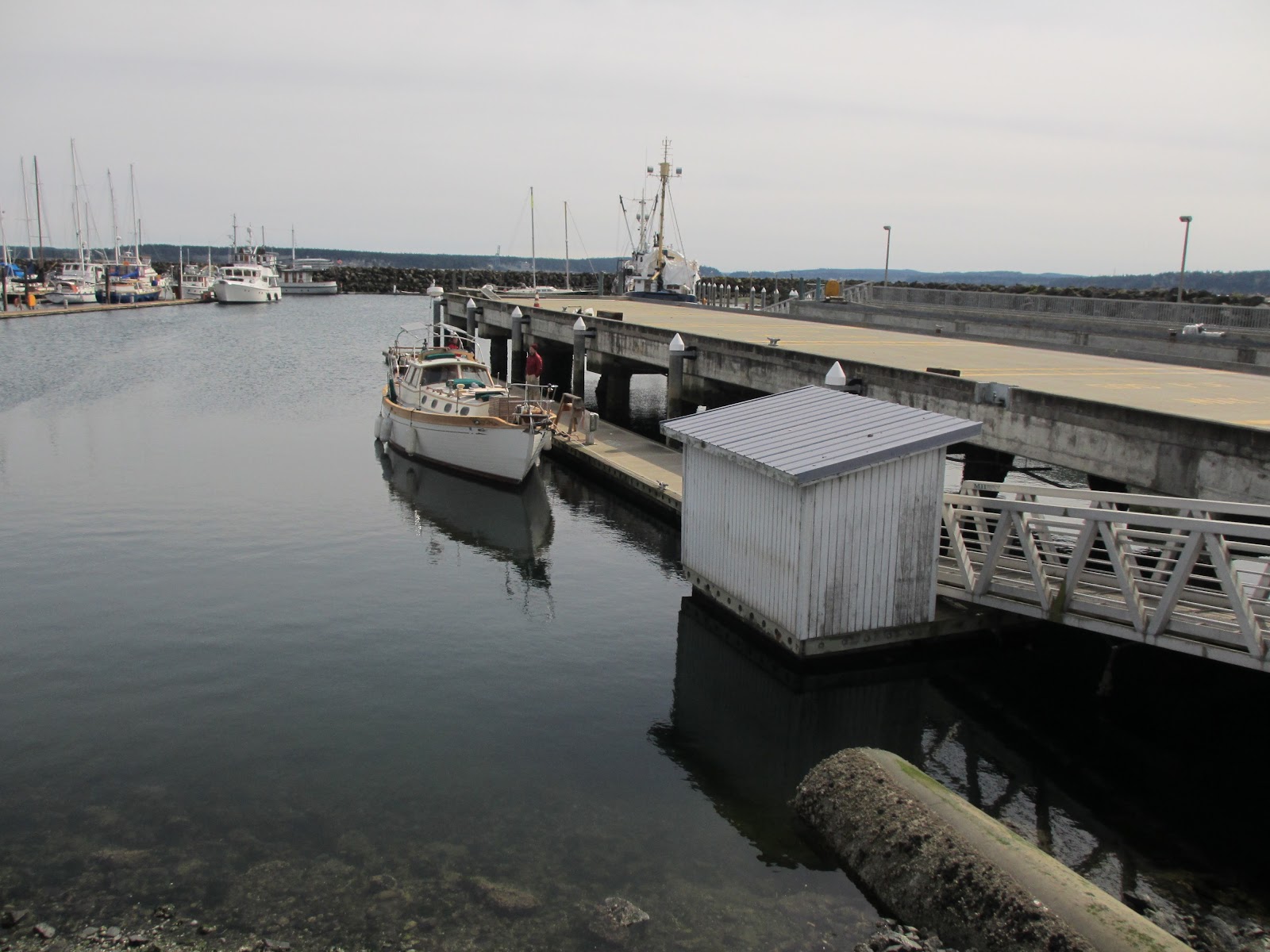
Brigadoon lay ready for her mast.

Gus the crane operator arrives as promised, making us very happy, after we have to cancel yesterday. He did some quick schedule juggling yesterday and wrote a check of hope he cashed today. It was great to see him arrive early.

And here comes the mast, for the second time in as many days.

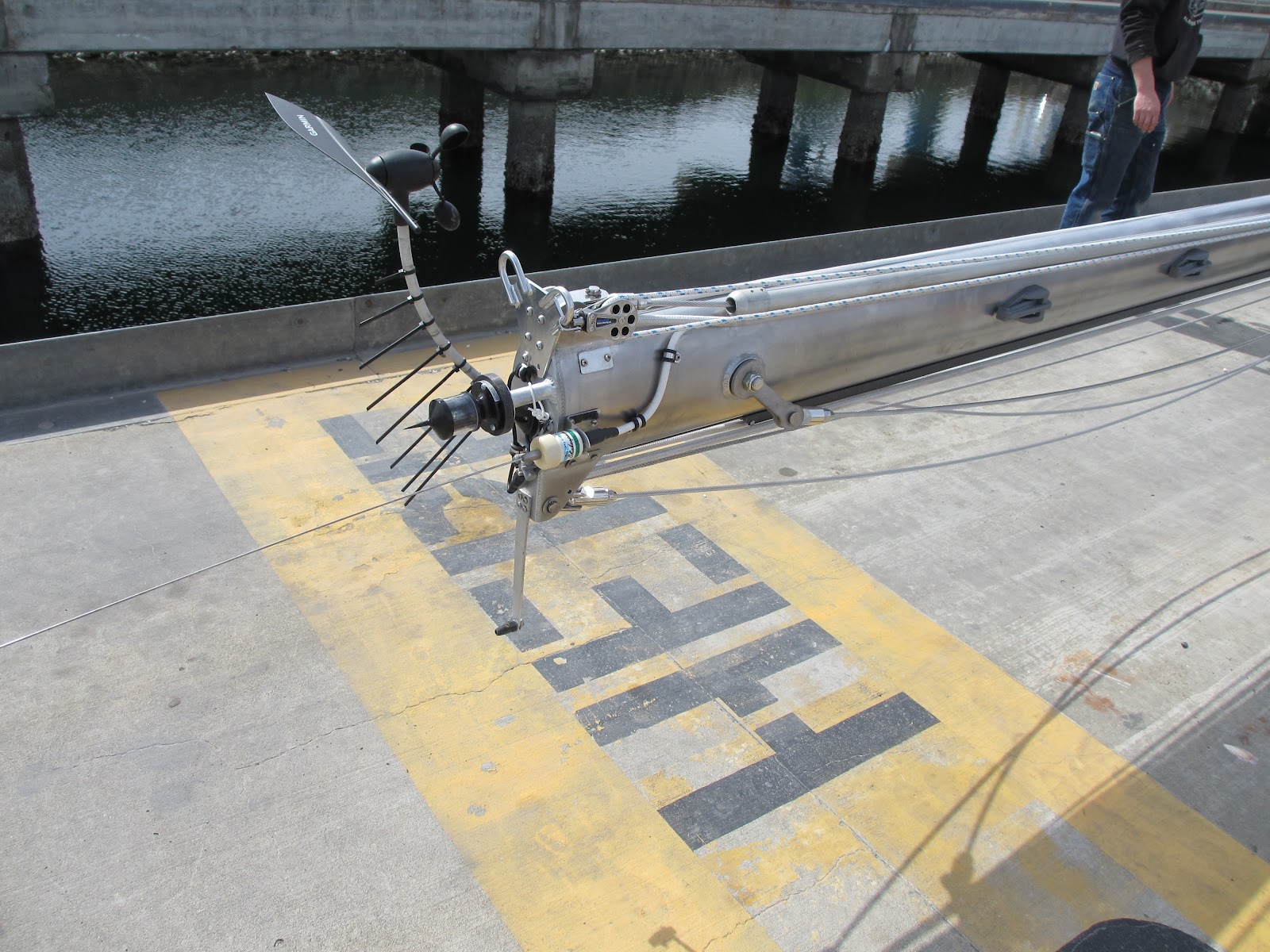
Masthead, with anti-bird Mohawk.


All wrapped up nice and safe.


Gus, the crane operator, rigging our mast while some guy who I have no idea who he is, tries to stuff a check at Gus. I was too busy to whip out my, "do you mind waiting just a moment and not distract my crane operator while he is rigging my job," speech. I still puzzle at it, looking at this photo.


Check guy goes away, the spar is rigged and up she goes.


Some very careful walking to Anders and Jeff...

Kerry hands it back to Jeff, who came down to the boat...

And we get ready to lower the spar.

Kerry clears the electrical, which has to feed down first.


Anders and Jeff, making sure it's right.


At this point the spar is mostly in the boat.

The unskilled help is sent below to catch the mast.

After some wiggling, the spar slipped onto the step.

Furlers are installed.


The smooth as glass marina made this job much easier. It would have been very difficult yesterday.


And there she is, with her spar standing and rigging good and snug.

Saturday, March 4, 2017

Competence as a Travel Partner

Refitting Brigadoon over the last two months has become a whirlwind of plans, discoveries, revisions, and shifting priorities. We are on the last month with just weeks to go. The marching days keep our attention and intent forward – always forward. Every time we turn around, there’s something we haven’t expected, even though we expected a lot.

Our days have been filled with sanding, cleaning, generators, impact drivers, electric calking guns, anchor chains, outboards, wind vanes, tiller pilots, sand blasting, spreader lights, water makers, solar installation, bilge pumps, bedding port lights, sealing windows, cleaning water tanks, masthead lights, and more...

Rudder inspection became a complete reengineering of our rudder and quadrants. Chain plate inspections ended up being after the fact, as we decided that replacement chain plates were just the right thing to do. Reengineering the chain plate covers meant a sometimes-torturous learning process in how best to cut and shape epoxy-fiber materials. A curiosity about our anchor windlass encouraged us to take a chance and try the old “clean it and grease it and see if it works now” trick that I’ve used many times on old machinery over the years – it worked, saving us an easy grand. I spent days sanding and polishing a 30 year old mast so we could build it right. 

On an almost daily basis, I’ve dredged into my past, pulling up old skills, applying what I know, however I can, to solve the latest challenge and get us there. Thankfully, my personal toolkit is varied and broad; that’s been by design. I’ve never wanted to be the expert at one thing, instead content and satisfied to be good at many. Good, in this case, means competent. Eighty percent mastery is good enough, if it’s in enough disciplines. With it comes a surety, a knowing that problems are solvable. 

Why?

My whole life’s experience has brought me here, to this place and time, where the kid who loved science, art and adventure, who collected experiences instead of things, can grow up to do this.


As I told Kerry the other night, “This is the happiest I’ve ever been. I don’t belong anywhere else or with anyone else. I belong here, with you.”


Tuesday, September 22, 2015

Asking for Help

On a Facebook group I’m on, a new boat owner recently asked for a little help. They had just purchased the boat and said they were a little nervous about taking her 30 miles to her new berth. Someone (that would be med) suggested just hiring a professional Captain for the trip. It would be a great learning opportunity.

This suggestion was immediately met with a dismissal.

“It’s only 30 miles. Who needs a captain for that? Just go do it,” they wrote.

This is the perfect dismissive advice to shame someone into doing something stupid. If someone says they want help, if they say they aren’t comfortable, it’s an honest thing to say. Asking for help means you are a better sailor, not a worse one.

Hiring a Captain is not a big deal. It's a learning opportunity. I've been sailing since I was nine. I know how to sail. When I bought Brigadoon (my largest, heaviest and most complex boat ever to date), I had been off the water for a decade. She is a serious cruising boat, with much heavier gear, higher loads, and a higher possibility for damage or injury. I knew how to sail but I wanted to ensure I was ready for Brigadoon.

I went to Seattle Sailing and hired a professional captain for a "checkride". When I was a pilot we did this all the time to ensure competency, good decision making, and safety. It’s required for pilots and for good reason. The good idea isn’t restricted to pilots, though. Why not get someone to check you out, give you an opportunity to learn, and make you a better (sailor, aviator, motorcyclist, climber, etc.)?  We went out in a comparable sized boat. He walked me through everything. I knew almost all of it but I still learned a thing or two.

There was another benefit. I had another experienced sailor’s eyes on me. They saw habits that are invisible to me. They suggested possible ways to do things. They provided me with some local knowledge.

I’ve always liked teachers. Years of studying under various mentors have driven home the value of being a student, of discovering how little I know about something, and how much there is yet to know. Competence blindness is an easy trap to fall into. We get comfortable with what we know. We ignore the shortcuts or mistakes we make because nothing bad has happened yet. We avoid learning some skills or taking on some challenges because, well, we don’t want to be challenged. It’s the easy thing to do; lie to ourselves about our skills and abilities because it’s convenient.

I welcome the observations, even the criticisms, of those with more experience, even just different experience, than myself. The outside eye is usually more honest than our own. It pays to listen to informed opinions.

Hire someone to teach you. Find a mentor. Learn from them.

It doesn't mean a person isn't competent. It means they are ensuring their competence is better than they would normally be willing to settle for. Don’t settle with what skills and abilities you currently have. You might think they are enough. You might be right. It will take just one situation where you are wrong.


Friday, July 24, 2015

Speed. There are many kinds...


I sometimes answer questions on facebook and realized some of them might be useful to share here.

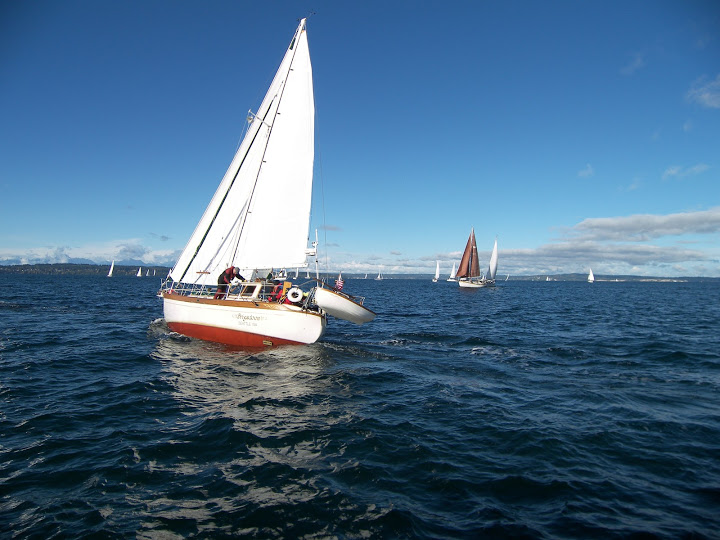
For example, in the photo above, we are making a whopping 1.8 knots. That is GPS, or actual speed. Water speed was about 5 knots.

There are different kinds of speed indicators for your boat.

Knowing the difference is useful when you are dealing with currents, be they caused by rivers, tides or wind.

Boat speed in water is the actual speed that the water is passing by the sensor and the actual speed your boat is making though the water. This is a combination of your boat progress and any currents. Those currents can add speed or take it away. One knot current against you will show the same water speed because your boat is moving though the water, and water is flowing past the hull.

GPS speed is measured against the surface of the earth. It is the actual speed, actual progress, you are making over the earth. It's your true speed.

If you are directly facing a one knot current and are showing five knots of water speed, your true speed would be about four knots.

If you are facing a five knot current, in a five knot boat, your true speed can be zero.

This is why it's useful to know the difference between the two numbers. They can tell you a lot about your surroundings.

Remember, your water speed is relative. The sum of your water speed and currents is your actual speed.

Thursday, July 16, 2015

Where is Home?


Brigadoon is our home. It’s been our home for the last five years. Over those five years we have been fortunate enough to live on Lake Union, here in Seattle. We have a great spot on the end of the dock, our marina is old but run well, we get along well with the owner, and our neighbors have (mostly) been good neighbors. They’re definitely a mixed bag. There was the guy who rode his motorcycle down the dock to park it next to his boat. There was the crazy cat lady who had flower pots all over her side of the dock for her cats to shit in. Entertaining us was the drunk Aussie who was offensive at times but overall a really nice guy. But they were all nice people – truly.

Then, there’s the shipyard…

Where is home? It’s where the boat is moored.

That is about to change.

A couple weeks ago, we were out on the Sound, returning from a friend’s place up north. Another friend was headed south also. As we sailed away, we had a nice northerly at 8-10, which made our asymmetrical spinnaker pull us along at a good 6 knots. Everything was going superb as we worked our way from Port Susan down past Hat Island, just off Everett. Our good friend, Kim, was sailing ahead of us about 3 nautical miles. The forecast was for possible dry lightning in the afternoon. We did get some, with flashes happening over the Cascades to the east, along with some between clouds. 

It wasn’t that severe and it wasn’t close, so we sailed on.

We had planned well for this trip, deciding to set watches for ourselves. This was the suggestion of my lovely and very smart First Mate. Kerry thought it would make for good practice. I agreed. So, we set watches of one hour on and one hour off. This kept us from standing around, fidgeting together, not resting, and basically not getting any time off. Kerry was below, off watch, when I saw the black line on the water.

It was about 5 nautical miles away.

I walked to the foredeck to get a better look. It was closer now. I could see black water, with ever increasing white caps behind it, like white horses climbing out of the Sound. Then I looked up. I looked up at our brand new spinnaker, full with only eight knots of wind filling it from behind. I knew that spinnaker had to come down right now. “Kerry! I need you on deck now!” I shouted as I moved forward to douse the spinnaker. The dark line on the horizon was now less than a mile away. 

There was a wall of wind coming at us, a squall, if you will, and it was going to hit us right on the nose. I completed the fastest spinnaker douse in my entire sailing career. Thank god I had an ATN sock on that spinnaker. It was doused and then down on deck in less than 2 minutes. And that’s when the storm hit us. Looking back I could see Kerry in the cockpit at the wheel.  She yelled out “What course should I take?” I looked over at Kim’s boat. I saw what he was doing. Turning back to Kerry, I shouted “Do you see Kim? Do exactly what he is doing!”

And she did.

We were fine. The winds were 25-30 knots. The seas were very confused. But we were just fine. We didn’t make any big mistakes and no one was hurt. The thing that most comes to mind is that, while not completely incompetent, we weren’t exactly relaxed in the process. Because, we should have been. We were in solid boat with good gear and enough experience where we should have been comfortable.

That’s the lesson. We need more of this. We need to be out there in the Puget Sound sailing in salt water and running into storms. Right now, we have a minimum of three drawbridges and the Ballard Locks to transit just to go sailing in Puget Sound. It’s a two hour trip on a good day. Lake Union is a little small and busy sometimes for Brigadoon. All this adds up to; We don’t get out often enough.

As of August 1st, we’ll be in our new slip on the Sound. We looked at many different marinas, some of them quite shabby but endearing nonetheless. Which begs the question – why would anyone, no matter how beautiful the marina might be, live in such a place with a dirty rundown bathroom and no laundry facilities anywhere in town? Three other marinas we researched were all in close proximity to each other.  Two of those were within walking distance of the Bainbridge Island Ferry.  We would have access to the Sound, a manageable commute, and a nice, modern, rich, town. Why didn’t we choose Bainbridge?

We found a better marina in Commencement Bay on the edges of the city of Tacoma. One cannot deny that Tacoma has revitalized the waterfront and, excepting its reputation, it’s actually quite a pleasant neighborhood. Oh, and the paper mill smell seems to have gone. The Foss Harbor Marina is clean, modern, well managed, amenity rich, and populated by some really nice people. There is a large liveaboard population, which is to our advantage.

This puts us within 200 yards from the entrance of Commencement Bay. At that point, we are in the South Puget Sound. We will have the time, the access, the desire, and the wherewithal to actually sail this boat as much as we need. The South Sound awaits us. We’re gonna do some sailing.


Monday, March 2, 2015

No One is Coming to Save You


I found this graffiti on Capitol Hill, here in Seattle. I was walking among the raucous and busy streets late at night when I spied this.

I stood there thinking, "This is, indeed, a truth."

There is a recent story of a father and son who arrived in Rhode Island late last year. They paid $10,000.00 for a 20 year old racing boat off eBay. They purchased this boat sight unseen. Their plans were to sail it back to Australia. When they told the seller their plans to leave and enter the North Atlantic in February, they were strongly cautioned not to leave in winter conditions.

"When he told me what he wanted to do, it didn't seem like a good idea to start with," the previous owner, said. "There's a reason there's no boats on the ocean in February. That's because it's not a safe place to be."

They didn't listen.

Now, after rescue, the sailors, both father and son, are spending a lot of time defending their choices and deflecting criticism. They have dismissed seasoned sailor's opinions that their rescue should have been unnecessary because their departure shouldn't have occurred in the first place.

They had planned to leave earlier, but repairs kept piling up, which pushed their schedule. They knew they were getting into times of bad weather but they let the schedule, along with their desire to get the boat home, influence their "go" decision.

So the USCG, in true competence and every-day heroics, rescued them off shore, in the middle of a snow storm.

Someone came to save them. We saved them.

Now, before we go any further, I'll state flat out that I am not discussing rescues, who pays for them and, if we all pay for them (mostly we do), who stops these people from 'wasting' resources with poor decisions. It's a waste of time to argue this. Nothing but circles and circles of rationalizations, victim blaming, Randian rationalizations about the convenience of 'personal responsibility' until the responsible person needs help, etc. Add the cries of glee by some that call this a Darwin award (like no stupid decisions were ever made by the speaker in their lifetime) and you have an almost perfect trifecta. One of narrow mindedness, armchair quarterbacking and an almost sociopathy in the disdain for the plights of others. Not going there, in this article at least.

I'm writing to talk about self-sufficiency and independence and the impacts on our decisions that inter-dependence engenders.

As the story above demonstrates, many are willing to 'take their chances' out there, on the understanding that, if something goes wrong, they can make a call, push a button, and someone will come and save them.

In many cases, boats that were abandoned have washed up on shore, or found floating intact and seaworthy. It's fear that drives people off boats in situations they don't understand and try to tackle in ignorance and unpreparedness. This is a common story, one that illustrates how unprepared many people are for the sea.

What if no one was coming to save you? What would you do then?

Perish at sea?

or...

Rescue yourself.

You rescue yourself every time you upgrade a critical system on your boat. You rescue yourself every time you learn more about weather, navigation and weather routing. You rescue yourself by carefully planning your routes without the driving date of a (sometimes arbitrary) schedule. In a hundred decisions before you leave, and hundreds after, you rescue yourself from ignorance, arrogance, hubris and laziness.

“The whole problem with the world is that fools and fanatics are always so certain of themselves, but wiser people so full of doubts.”

—Bertrand Russell (British mathematician and philosopher, 1872-1970)

When you read the stories of rescues, one common theme seems to rise up above all the other noise. The sailors being rescued were very confident, very sure of themselves, cannot be dissuaded by more experienced sailors; they aren't interested in information that flies in the face of what they want to do. These people are the same type who enter the wilderness without training, equipment and experience, ending up with a rescue by SAR volunteers. The arrogance of ignorance is poison to taking on endevours such as sailing.

"Aviation in itself is not inherently dangerous. But to an even greater degree than the sea, it is terribly unforgiving of any carelessness, incapacity or neglect."

— Captain A. G. Lamplugh, British Aviation Insurance Group, London. c. early 1930's.

The problem with this, as documented as the Dunning-Kruger effect, is that the incompetent don't know they are incompetent. They are often the ones so sure, so without doubt, as they stumble along to their eventual failure and doom. The sad part of, because of that self-blindness, that lack of doubt, they can never really get any better.

A good sailor (or aviator for that matter -- of which I am both), doubts. I'm not talking about the paralytic doubt that freezes one into inaction. I mean the kind of doubts that fuel us to redouble our efforts to sail a safe and seaworthy boat. We doubt our knowledge is good enough, so we study. Our skill set may not be there yet, so we work on our engines, our systems, our rigging and ourselves.

We see the trap of expecting someone else to help us in our darkest hour, so we do every single thing we can do to plot a course where that darkest hour doesn't come to pass. We rescue ourselves in every decision we make because, deep down, in our bones, we know, we really know...

"No one is coming to save you."

We have to save ourselves.


Friday, February 13, 2015

Living on the Cheap. Dying on the Cheap.

Boating, actually sailing, for that matter, is not a cheap sport. The inherent problem with owning a boat is the fact that, unlike cars, they aren't as mass produced. Sometimes, no one has the off-the-shelf part you need, so, you have to have it made. That's even more expensive.

What we have to understand about the prices we pay is that not all of them are unfair, or necessarily a ripoff. When a company does the R&D for an item and only sells 10,000 units, they will recover that cost in the price per unit. Actually, they must recover that cost or they cannot stay in business.  If the same unit was going into 5 million cars, they can spread the R&D out a bit and the cost comes down.

Does this mean that some marine supply stores don't sell the *exact* same thing you can pick up at the local hardware store for what seems like half the price? Of course some of them do. They play on the "everything on a boat is expensive" game and, some people pay it.

But what if you don't want to pay it?


See that? This is a perfect example of going on the cheap. It's a photo of wire nuts and short pieces of odd spliced wire on my bilge pump. They don't belong there. The wires were also non-marine (not tinned) and were corroded where the wire was nicked. The pump failed. For lack of a handful of waterproof crimp connectors, a crimping tool, and a couple feet of tinned wire, I had no bilge pump. The house water pump was wired the same way too. Someone before me tried to save about $50.00 on a cheaper bilge pump for their $100,000+ boat. If that pump failed to run and Brigadoon had water intrusion while we were away for the weekend -- sunk boat.

The solution is not to "go on the cheap". Going on the cheap bends your sense of reason. It drives you to get the best deal, which is only measured by getting the cheapest price. It frequently means the person going on the cheap has a big pile of rationalizations why their cheap unit is as good as your more expensive unit. Most of the time they are wrong, as they try to defend their decisions.

Price isn't the only factor here, people. Sure, in America, where we value price above everything else. We don't care where our iPads or iPhones are made, or under what conditions, as long as we get it at a good price.

What matters is value for the dollar. How many times have any of us bought the cheaper of two items, only to have it fail or break on us. We get upset. "Damn cheap Chinese crap!"

But, who bought that, "Damn cheap Chinese crap?"

It's taken me a while to get over my early training. You see, my father served in the military in this country for 23 years. We had a family of six. My father worked second jobs. My mother worked. We were military poor. I was raised in an environment of scarcity, of worry over money, for fear of survival.

Fortunately, today, things are different for us. We have valuable skills that we can sell in corporate environs. We are beyond simply surviving and, for that, we're thankful. In our efforts to pay down debt and becoming truly "free", free from the yoke that debt puts on our shoulders and gives our creditors power over us. So, we shovel money towards debt (might be zero in mid to late summer).

I don't live in a environment of scarcity anymore but, that doesn't mean I'm foolish with my money.

So, what does this have to do with "going on the cheap"?

Everything.

My background of scarcity might drive me to go on the cheap. However, I've learned, over the years that quality matters. If I'm trusting my life, I said, "trusting my life", to the safety and seaworthiness of my vessel and her systems, my primary motivation is not to save a dollar today only to die one dollar richer because a cheap unit failed.

There is always something cheaper that you think can do the job my thing does. I will not argue that. I will argue that, if price is your only consideration, you will get shortchanged eventually, perhaps at great cost, maybe a life.

Balance quality in what you do. You invest in quality and buy the best you can afford.

Save money in creative ways. Anchor out. Cook on board. Learn to splice your own lines. Don't buy useless doo-dads to hang fenders with. Learn to tie a round turn and two half hitches -- you already own the line on the fender. Learn how to use it. Save money in practical ways. That way, it's there when you need to buy the best diesel filtration, bilge pumps, safety harnesses, sails, and engine parts you can afford.

How has this worked out for us?

Our battery replacement project coast 5K. It ended up with the right parts, the right install, and a reliable and flexible system.

Our Portland Pudgy Dinghy and Active Rescue System was almost 5K with the electrical system and sail rig. The lifeboat canopy for this lifeboat (more than just a dink) will cost another $2,500. However, a life raft can cost about $5,000 plus an additional $1,000 a year to certify for a one time use item.

Our planned wind vane self-steering system will cost about $5,000, plus install. Aside from steering our boat so we don't have to, it provides a completely redundant rudder for Brigadoon. If our rudder fails, we can still steer. That's value added to the primary purpose of the unit.

Our sails cost about 14K. Yes, I could have paid less. I could have gone to any number of companies that took measurements (some have you measure) for sails made in Southeast Asia. We could have gotten those sails for about 40% off. Yet, our sails are clearly of a better quality. They are made locally, here in Pt. Townsend. Sail material arrives at one end, and finished, hand-made sails of the highest quality come out the other. Our vendor is here. That is valuable to us.

All these decisions were weighed on value. It was value that drove us to these purchases. It was value that drove us to save the cash for these purchases so we aren't in debt. Our money is our life energy. We sell our souls, our time, to corporations so we can have nice things. We won't waste money but we won't be afraid of quality either.

There are many ways to save money, yet still have quality. Yes, the stainless hardware (if it's the right quality) is just fine for marine use. Alkyd Enamel paint from any quality paint vendor will work just fine in marine applications and will be about half the cost of 'marine' paint. Heat shrink from my hardware store is cheaper -- it's still the same stuff. So, there is nothing wrong with finding value at a cheaper price.

Just don't buy crap that fails that you have to replace. Don't be cheap on stuff that can affect the safety of your boat or yourself.

I see it time and time again, in person and on the net. People put non-marine propane installations in boats. Use the cheapest lines they can for mooring lines. Buy the cheapest chain for anchoring. Thin wall stainless tubing is cheaper than thicker wall stuff. It's also weaker. Cheap anchors bend and break. Cheap light fixtures burn up. Cheap electronics fail. If all you look at is price, you will get burned, sooner or later.

Don't be so focused on living on the cheap that you end up dying because of it too.


Monday, October 27, 2014

It's Been a Long Time, But my Time is Finally Here


Man, it's been an interesting last few weeks. Kerry has been away at rehearsals for a production of Fiddler on the Roof. I've spent many an evening alone, and have been passing the time working on various projects, but mostly relaxing in and watching some streaming TV. I've picked watching the Star Trek Enterprise TV series on Amazon. Anyway, the point is, as I listen to this song, I've learned to sing it. As I've looked out the pilot house windows in the evening, this song really seems to speak to me. Cheesy, simplistic lyrics can still be inspirational at times.
***********************************************************
It's been a long road
Get'n from there to here 
It's been a long time 
But my time is finally near
I will see my dreams come alive at last 
I will touch the sky
And they're not gonna hold me down no more 
No they're not gonna change my mind
'Cause I've got faith of the heart 
I'm going where my heart will take me 
I've got faith to believe
I can do anything 
I've got strength of the soul 
No one's going to bend nor break me 
I can reach any star
I've got faith
I've got faith
Faith of the heart
***********************************************************
I've so many dreams in my life where I let others hold me down, where I let others change my mind. Fortunately for me, I'm a dreamer so, if one gets quashed another magically appears. It's a Phoenix-way of reinventing myself when necessary. I once wanted to learn to sail, then own a boat, then really sail to far off places. I learned to sail, eventually owned my first boat but never really thought my dream would come alive at last. It got sidetracked for reasons many but, my time is finally near.
I've been immensely fortunate to have been partnered with someone who loves adventures and traveling. She is willing to take risks with me, to plan a grand adventure, and to work to execute that adventure. 

As I sit there, in the pilot house, looking out over the waters of Lake Union, I imagine them as being in a different place. Maybe it's an anchorage in the South Pacific, a dock in Australia, or some harbor in Scandinavia. It doesn't matter where it is so much as the journey of going, of arriving having seen and done things never before.

I can sense it. The journey approaches, slowly but surely. It will arrive and we will depart. Some day.
I can sense it.

Wednesday, September 17, 2014

When opportunity knocks….


A Post from Kerry (First Mate, SV Brigadoon)

Last February I was attending the Annual Women’s Boating Seminar being held on the North Seattle Community College campus.  It’s a wonderful day full of seminars and talks about boating – both sail and power.  For women, by women.  A great chance to chat up fellow female boaters and learn a few things.  It wasn’t my first time attending, and at this point I’ve been around enough boat shows and seminars in the last four years that I’m starting to get on a first name basis with some of the region’s most inspiring female boaters.  At lunch I found myself sitting around a table with many of the speakers from the day – Wendy Hinman, Judy Nasmith (who also organizes this fun event), Nancy Erley, and Linda Lewis.  All women I’d seen speak before – full of knowledge, experience, and a lot of passion for being on the water.  Later in the afternoon, Linda approached me between sessions and casually asked if I had any extra vacation time to use up this summer.  I smiled and told her that yes, actually, there was a chance I might have some extra time I could use….  “Why?”  She said she was planning to take her annual trip up to the Broughton Islands and was looking for crew – would I be interested?  My first instinct was to step back and tell her that I couldn’t possibly take the time off necessary to go with her, but then I thought better of it and just said that I’d love to chat more about it when she was ready to start planning out her trip. 

Four months went by and I completely forgot about this conversation.  Then I got her phone call.  Linda called me in June and told me she was starting to put together her roster and itinerary and did I still have time off I could use?  I said I’d have to talk to my managers and Donn, but that yes, it was possible.   We narrowed it down to a vague time frame and I told her I’d get back to her in a day or so.  As I checked at work and with Donn, I was met with complete support and excitement for me to go on an adventure.  When all was said and done, Linda and I agreed that I would fly up to Blind Channel, meet her as she was making her way back south at the end of August, and crew for her for seven days, ending up in Anacortes on Labor Day if all went well.  As we chatted on the phone about the logistics, I asked “who else will be on the boat?” – She replied that it would just be her and me. 
Captain Linda Lewis teaches boating.  She teaches navigation classes through the Coast Guard Auxiliary, which is how I met her in the first place.  I knew that this opportunity would afford me some amazing one on one time, with her, on her boat, learning about new waters and soaking in everything I could in seven days.  The weeks went by as I waited for the day I was to fly out on a float plane from Kenmore Air on Lake Washington.  The morning of August 25th was beautiful.  Donn dropped me off at the docks and we parted ways.  I was nervous and excited – having never been on a float plane before.

We landed in Nanaimo as we made our way north, so we could check in to Canada, and the pilot could refuel.  Taking off again, the pilot informed me we’d be in Blind Channel in about 45 minutes.  I can’t express how beautiful the world below looked.  I followed on the rudimentary map they provide, as I picked out which islands were which as we glided over them.  Tiny specks of boats were below me, making their way north or south, through the Strait of Georgia.  I knew that’d be us soon enough.


I realized we were now flying over the island just south of Blind Channel – East Thurlow Island.  The hills full of trees were getting closer as the small plane followed the curves of the land down to the channel below, making another smooth landing.  We snugged up to the dock, I grabbed my bags and stepped off to find Linda waiting for me with a big smile on her face. 

She led me back to her 45 foot trawler – “Royal Sounder”.   A 1978 KhaShing power boat.  She’s got classic lines and a beautiful bow.  Linda and her husband have maintained her beautifully and she really is a comfortable and sturdy vessel.  Linda showed me around, showed me where I’d be sleeping and where I could stow my belongings.  She pointed out a few things that we’d get more in depth on later.  Then as we stepped out on the deck to head up to land for lunch, a couple on one of the neighboring boats told us to look out in the channel.  A small pod of orcas were swimming through.  I’m pretty sure I saw at least one adult and two babies – my first sighting of whales in the wild ever!  I figured it was a good sign to be welcomed so warmly by the orcas just after arriving.  J
After a nice lunch and some texts to Donn to let him know I’d arrived safely, we headed back to the boat.  We discussed our route for the next day.  We had a bit of a dilemma because of the currents the next morning.  As we talked over our options, I felt a strong pull to head east towards Dent Rapids.  It seemed like a more interesting choice.  She agreed with me, but also acknowledged that we couldn’t make it to Dent in time for slack from where we were, even if we left at first light.  So the decision was made to make it a short trip to Shoal Bay, leaving around 9:30 or 10, catching the current east and easily reaching Shoal Bay before Noon.  We would then proceed through Dent and the other passes the following day, easily accomplished from the closer location.  Then Linda started explaining in more detail what our respective roles would be around docking, anchoring, and while underway.  Her processes were detailed, clear, and very thorough.  I knew I was in good hands.
We awoke early – she whispered down to me to see if I was awake yet and asked if I wanted to see something amazing.  I hopped up quickly and went out on deck to see one of the most beautiful sunrises I’ve ever witnessed (photo above!).  As the pace of the city started to fade away a bit, I began to truly breathe in the beauty and quiet around me.  It was gorgeous up there.

As she had shown me the night before, I got the lines ready for departure.  In Canada, most of the docks use “bull rails” and not cleats as we’re used to in the States.  I had used bull rails before, but not often and hadn’t yet mastered a good process.  That was about to change.  In seven days, I learned, struggled and somewhat conquered bull rails and how best to work the lines around them when docking and departing.   I think we had conversations almost every single day while we were under way about techniques and tricks on how best to work with them.  Cleats are like a walk in the park now!

Another cool tool she uses is headsets.  These are AWESOME!  Donn had reconfigured some motorcycle headsets for use on our boat, but we hadn’t had a chance to use them yet.  On this trip I learned just how much they can help keep things calm, and organized.  So we had on our headsets, she was at the helm, and I was on the boat ready to release the lines.  Everything went smoothly as we pulled away from the dock.  Then we switched places.  I manned the helm as she went outside to release the skiff away from the boat’s port side hip and back behind to the end of the towing line, where it stayed while underway.

Dock at Shoal Bay


Shoal Bay was beautiful and quiet.  A small community of volunteers run a small pub out of a living room and maintain a garden and a chicken coop.  For a donation you can garden a bit, harvest a few things, and possibly get a few eggs if you so desire.  We wandered, then headed back for the daily happy hour on board.  These were some of my favorite times – we’d sit back, we’d each have one beverage of choice, along with a few snacks and just talk.  This was our first chance to really get to know each other, as we’d never spent time together outside of a boating class.  As the days wore on we laughed a LOT and were delighted with how many things we seemed to have in common.
The next day we timed our departure to catch Dent Rapids at slack.  She made sure I was at the helm, so she could get the requisite photo of me yawning through the boring waterway, which only a few hours before had been running at 9 knots.  Gillard Pass and Yaculta Rapids were equally as exciting.  We made our way to Von Donop Inlet where we had decided to spend the night at anchor.  As we eased in to the Inlet, following two other boats, we worried it might be crowded.  We made it to a wonderful spot where other boats had settled in, but where there was still plenty of room.  I was at the helm, with Linda at the bow looking for just the right spot.  I read out depths to her as we circled around slowly like a cat picking its spot in the sun.  She directed me at the helm as she lowered the anchor.  Soon enough we were dug in and ready to relax for the rest of the afternoon and evening.  It was warm out and I was so tempted to get my bathing suit on and go for a swim, but she dissuaded me with a warning about the coldness of the water.  I grabbed a PFD and tether and climbed down to the swim step.  Rolling up my pants, I stuck my feet in the water.  It was cold, but felt so good.  I stayed down there a while, just lying on the swim step, looking up at clouds quietly drifting by.  Being at anchor, especially in a protected, quiet anchorage, is incredibly peaceful.  I slept well, knowing we’d be up with the sun again to get underway by 6:30am.

Westview Marina - looking back at the entrance

The next day brought us closer to civilization.  We made it to the Westview Marina, near Powell River on the BC mainland.  After docking and getting the boat squared away, I headed up in search of a shower and a chance to walk around a bit.  Later that night we found a great Italian restaurant “Snickers”.  We were craving pizza and each ordered our own personal pizzas.  I went on to amaze Linda with my ability to put away food.  This became a running joke for the rest of the trip….   
Another early departure started us off on our longest day of the week.  We had hit a perfect weather window to cross the Strait of Georgia and head to Nanaimo.  We maintained a shift schedule of one hour on, one hour off.  It was a long day, with waves coming at us from the north as we crossed SW, but they never got too strong and we maintained an excellent course.   I think we made it in about six and half hours.

Each day of the journey I learned more about the various instruments and tools at the helm and how I could best use them to help make decisions about other boats, our course, etc.  We were using the autopilot much of the time, which was nice.  I kept watch by looking outside, then glancing at the radar, and then at our course on the navigation software on her laptop.  I learned how best to use the radar to determine whether other boats around us posed a threat if they were heading our direction.  So simple, but so effective – and reassuring.

Radar shot while at anchor in Monague Harbor


We arrived in Nanaimo tired and the docking process ended up being a touch stressful, with a strong current pushing us away from the dock and a marina employee who was less than helpful.  But we managed to get tied up safely and settled in.  I realized that after such a long day I needed some alone time, so I bid Linda adieu and headed out in search of a shower and some comfort food.  I also allowed myself to call Donn for the first time since leaving.  Up until then we had texted at least once or twice a day when I had cell coverage.  By the time I got back to the boat in the early evening, I felt more rested and relaxed.  Linda showed up a little while later and we enjoyed another nice evening talking and sharing stories.

The next morning we left on the early side to make it to another pass at slack time.   Once again I was at the helm as we made our way slowly through Dodd Narrows.  Then it was a straight shot down to Montague Harbor where we anchored for our second time, surrounded by boats enjoying the end of the summer.  It was Saturday of Labor Day weekend.  Once we had anchored securely, we realized we had a nice quiet afternoon stretching in front of us.  We separated to our respective berths.  I napped, watched a movie I had downloaded onto my Kindle Fire for the trip, and read a bit.  It rained off and on and created an incredibly cozy day.  There was no doubt in my mind – I was in love with this life on the water and I couldn’t wait to come back up here with Donn on our own boat.
Sunday brought us back into the US, where we checked in at Roche Harbor and anchored close by in Garrison Bay.  Then we hopped into Linda’s 17 foot skiff, built by her husband, and motored back to Roche to get some ice cream and check out the sights.  I went on walkabout and explored the Sculpture Park and the Mausoleum.  It’s a beautiful place, and being Labor Day weekend, the marina itself was packed with boats.   We headed back to the boat before sunset, had a nice final dinner together and went to bed early, ready for another early morning to head out on our last leg to Anacortes.

Grinning like a cheshire cat as we glide through Pole Pass


Monday’s trip to Anacortes stared off with the sun shining directly at us from the sky and the water.  It was blinding and I wasn’t quite sure how to keep watch.  I used my sunglasses when looking out and then pushed them down my nose when I needed to see the instruments.  An hour or so in, we changed direction just enough to change the angles for the better.  One more pass – Pole Pass on the south end of Orcas Island and then we were home free.  We made it to the dock at Anacortes by 11:30am with Donn waiting for us at the dock, ready to catch our lines.  It was a pretty awesome way to arrive back to the mainland.

Happy Reunion!


Overall we had amazing weather and for the most part were able to use currents to our advantage.  We kept our speeds between six and eight knots for the most part.  I worked hard, relaxed deeply, and truly enjoyed getting to know Linda better in the seven days we were together.  I also came home with a list of ideas and processes I hope to adapt for us and our boat.  Some of these include docking practices, others include timing of keeping watch and manning the helm.  I think the most valuable thing I brought home with me was a sense of inspiration and accomplishment.  I feel empowered and capable in ways I haven’t before.

It’s been two weeks since my return.  This past weekend, I suggested we take our boat out into the lake early on Sunday morning so I could practice docking at Ivar’s dock just east of Gasworks.  No other boats around and hardly a whisper of wind – perfect conditions.  We used our headsets, I was at the helm the entire time.  Donn talked me through departure from our dock and then docking and undocking at Ivar’s.  Then we came home and I docked at our own dock, which has its own challenges.  I glanced our pulpit off of one of the posts that stick up from our dock, but otherwise, nothing damaged, and no one hurt.  All good.  After four years, I finally got up the courage to dock my own boat.  And that’s huge. 


Many thanks to Linda for the opportunity to join her, the encouragement, and the wonderful fellowship.